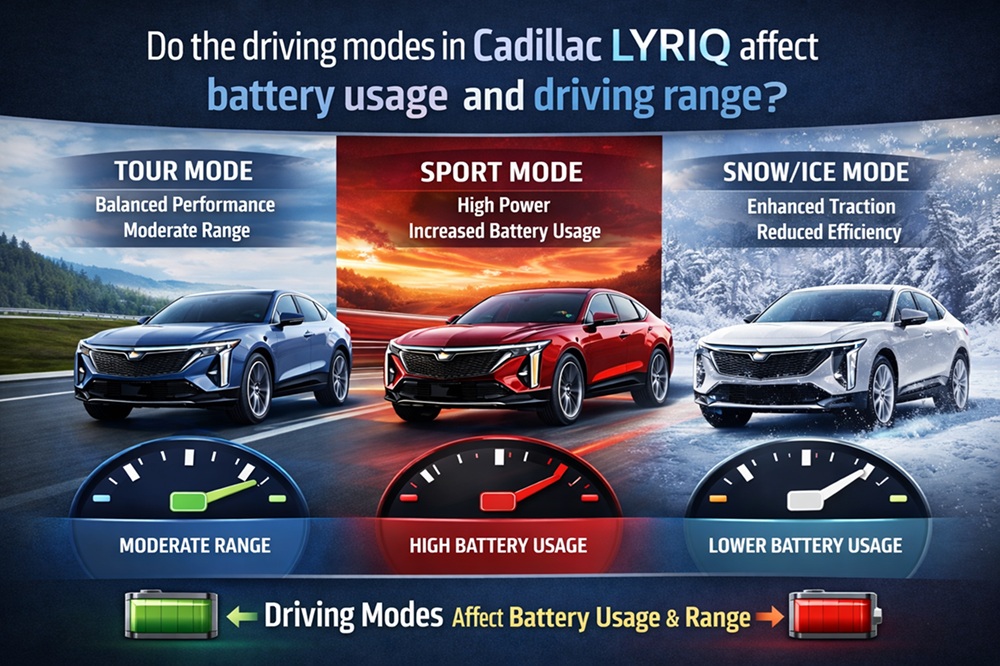

If you’ve been wondering whether switching between driving modes on the Cadillac LYRIQ actually changes how far you can go on a single charge — the short answer is yes, it absolutely does. The LYRIQ’s driving modes don’t just change how the car feels; they actively shift how aggressively the powertrain draws from the battery, how much energy the regenerative braking recovers, and ultimately how many miles you squeeze out of a full charge.
In practical terms, driving in Tour mode with One-Pedal driving enabled gives you the most efficient experience — close to or matching the EPA-rated range of around 314 miles (2024 RWD model). Flip it into Sport mode for an extended stretch, and you could see a noticeable drop in that estimate, sometimes by 30–50 miles or more depending on your driving habits. The difference is real, and understanding it can change how you use this car daily.
What Driving Modes Does the Cadillac LYRIQ Actually Have?
The LYRIQ comes with a handful of modes that cover different driving situations. They’re not just cosmetic — each one adjusts real parameters under the hood (or rather, under the floor, where the battery lives).
| Mode | Description | Best For |
|---|---|---|
| Tour | Balanced, everyday driving | Commutes, highway cruising |
| Sport | Sharpened throttle, firmer feel | Spirited driving, fun runs |
| Snow/Ice | Conservative torque delivery | Winter roads, slippery conditions |
| My Mode | Fully customizable by driver | Personal preference blend |
| One-Pedal Driving | Aggressive regen on lift-off | City driving, stop-and-go traffic |
One thing worth noting: One-Pedal Driving isn’t technically a standalone “mode” in the same menu — it’s a setting that can be toggled and works alongside the other modes. But its effect on energy recovery (and therefore range) is significant enough that it deserves its own spotlight.
How Each Mode Affects Battery Usage and Range
Tour Mode — Your Everyday Efficiency Champion
Tour is the default, and for good reason. The throttle mapping is smooth and linear, the suspension settles into a comfortable middle ground, and the powertrain isn’t trying to impress anyone. It draws power from the battery at a steady, reasonable rate.
For most drivers doing daily commutes or relaxed highway miles, Tour mode is where the LYRIQ earns its EPA range rating. If you’re targeting 300+ miles on a charge, this is your mode.
Sport Mode — Fun Has a Price
Sport mode sharpens everything — throttle response, steering weight, and the way power rushes in when you press the accelerator. It’s genuinely enjoyable to drive. But that quicker throttle response means the motor is pulling harder from the battery more frequently, even during casual acceleration.
On longer drives or highway runs, Sport mode can eat into your range meaningfully. Drivers who’ve tested both modes report that sustained Sport driving can reduce effective range by anywhere from 8% to 15% compared to Tour — sometimes more if you’re actually using that extra responsiveness.
Snow/Ice Mode — Safety First, Minor Range Trade-Off
Snow/Ice mode deliberately softens power delivery and manages torque carefully to prevent wheel spin on slick surfaces. It’s a conservative mode by design. The range impact here is relatively minor — you’re not asking the motor to work dramatically harder, just differently.
The bigger range killer in winter conditions isn’t the mode itself — it’s the cold temperatures reducing battery capacity, cabin heating loads, and slower traffic. Snow/Ice mode is the right call on bad roads regardless of any small efficiency trade-off.
My Mode — As Efficient or Wasteful as You Make It
This is where it gets interesting. My Mode lets you mix and match settings — you can have Sport steering with Tour-level powertrain response, for example. The range impact depends entirely on what you configure.
A smart My Mode setup — say, Tour throttle mapping with maximum regen braking — can actually rival pure Tour mode for efficiency while still letting you personalize the feel. An aggressive My Mode setup (full Sport everything) will behave like Sport mode in terms of battery draw.
One-Pedal Driving — The Secret Weapon for City Range
When you lift off the accelerator in One-Pedal mode, the LYRIQ aggressively harvests that kinetic energy and sends it back into the battery. In stop-and-go city traffic, this can meaningfully extend your range compared to driving with minimal regen.
On the highway, the benefit drops off — there’s less opportunity to brake and recover energy. But in urban environments, pairing One-Pedal driving with Tour mode is about as efficient as the LYRIQ gets.
Mode-by-Mode Breakdown Table
| Mode | Throttle Response | Regen Level | Estimated Range Impact vs. Tour |
|---|---|---|---|
| Tour | Smooth, linear | Moderate | Baseline (0%) |
| Sport | Sharp, immediate | Moderate | –8% to –15% |
| Snow/Ice | Soft, controlled | Moderate | –2% to –5% |
| My Mode (efficient setup) | Configurable | Configurable | –0% to –5% |
| My Mode (aggressive setup) | Sport-like | Variable | –8% to –15% |
| Tour + One-Pedal (city) | Smooth | High | +5% to +12% gain |
Note: These figures are estimates based on real-world driver reports and general EV behavior. Actual results vary with speed, temperature, terrain, and individual driving style.
Regenerative Braking — The Range Factor Most People Underestimate
Regen braking is one of those things that EV newcomers often overlook, but experienced EV drivers swear by. Every time you lift your foot off the accelerator or press the brake, the electric motor essentially runs in reverse — acting as a generator that pushes energy back into the battery pack.
The LYRIQ gives you control over this. You can adjust regen intensity through the center console paddle shifters (or through settings depending on trim). Low regen feels more like a traditional gasoline car — the vehicle coasts freely. High regen means the car slows down noticeably the moment you ease off the gas.
In city driving with lots of stops, high regen (or One-Pedal mode) can recover a meaningful amount of energy. Think of it this way: every time you’d normally be pressing the brake pedal and turning kinetic energy into heat, you’re instead capturing it as electricity. Over a 50-mile city commute with dozens of stops, that adds up.
On the open highway at steady speeds, regen matters less — there’s little stopping and starting. In that environment, Tour mode’s efficiency advantage comes more from its conservative power delivery than from regen recovery.
Real-World Range Numbers to Keep in Mind
The 2024 Cadillac LYRIQ RWD carries an EPA-estimated range of 314 miles. The AWD version comes in lower at around 307 miles due to the added weight and dual-motor power draw. These figures are measured under standardized conditions that roughly mirror Tour mode driving.
Here’s a realistic look at what range might look like across different scenarios:
| Driving Condition | Mode | Estimated Real-World Range |
|---|---|---|
| Highway cruise (65–70 mph) | Tour | 280–310 miles |
| Highway cruise (65–70 mph) | Sport | 255–280 miles |
| City commute (mixed stops) | Tour + One-Pedal | 290–330 miles |
| City commute (mixed stops) | Sport | 260–285 miles |
| Winter driving (cold battery) | Snow/Ice | 200–240 miles |
| Mixed suburban driving | My Mode (efficient) | 275–305 miles |
Cold weather is the wildcard here. Lithium-ion batteries lose capacity in low temperatures, and running the cabin heater draws additional power. Even in Tour mode, winter range can drop 20–30% compared to mild weather driving. That’s not a mode issue — it’s battery chemistry meeting physics.
Tips to Get the Most Range Out of Your LYRIQ
Getting close to the EPA-rated range consistently takes a bit of intentionality. Here are things that actually move the needle:
Use Tour mode as your default. Unless you specifically want the Sport experience, there’s no reason to run in a mode that draws more power without a clear benefit. Tour mode isn’t boring — the LYRIQ is still a very capable, comfortable car in Tour.
Turn on One-Pedal driving for city commutes. The more stop-and-go traffic you face, the more valuable regen becomes. Getting comfortable with One-Pedal driving takes a few days, but most drivers say they never go back.
Pre-condition the cabin while still plugged in. If you’re charging at home, use the scheduled departure feature to heat or cool the cabin before you unplug. That way, the energy for climate control comes from the grid rather than the battery. This alone can preserve 10–20 miles of range in extreme temperatures.
Watch your speed on the highway. Aerodynamic drag rises sharply above 65–70 mph. Driving at 80 mph vs. 65 mph can cost you 20–30 miles of range regardless of mode. Tour mode helps, but physics wins in the end.
Check the Energy Usage display. The LYRIQ’s infotainment shows a real-time energy flow readout. Glancing at it occasionally helps you understand how aggressively you’re drawing from the battery. It’s a good calibration tool, especially when you’re new to the car.
My Mode — Is It Worth Setting Up?
Honestly? Yes — but it takes a little experimentation to dial in.
The most useful configuration for efficiency-minded drivers is to keep the powertrain setting on Tour (smooth throttle) while adjusting steering and suspension to taste. If you prefer a firmer, more connected feel without the battery penalty of Sport mode’s aggressive power delivery, this is exactly the kind of compromise My Mode was built for.
For drivers who prioritize range above all else, a full Tour-equivalent My Mode with max regen is a solid choice. For those who want a sporty feel but not maximum battery draw, a partial Sport setup (steering and suspension in Sport, powertrain in Tour) is a clever middle ground.
My Mode is less useful if you’re someone who just wants to set it and forget it. In that case, Tour or Sport depending on your preference is simpler. But if you like tweaking things, the customization is genuinely deep and worth spending 10 minutes on.
How Does the LYRIQ Compare to Competitors on Driving Modes?
Every major luxury EV has some version of a mode system. Here’s a quick look at how the LYRIQ stacks up:
| Brand / Model | Mode Options | Range Impact | Regen Adjustability |
|---|---|---|---|
| Cadillac LYRIQ | Tour, Sport, Snow/Ice, My Mode | Moderate difference | Yes, adjustable |
| Tesla Model Y | Chill, Standard, Track | Significant in Track | Adjustable (via menu) |
| BMW iX | Efficient, Comfort, Sport, Personal | Moderate difference | Yes, with paddles |
| Mercedes EQS | Comfort, Sport, Individual | Moderate difference | Yes, adjustable |
The LYRIQ’s system is competitive — it’s not dramatically better or worse than what BMW and Mercedes offer. Tesla’s Track mode, if you enable it in the Model Y Performance, probably has the most dramatic range impact of any mainstream option. The LYRIQ’s Sport mode, by comparison, is spirited but not extreme.
What gives the LYRIQ an edge is the integration of My Mode — Cadillac lets you genuinely mix parameters from different modes, which BMW and Mercedes also do but sometimes with more complexity in the menus.
Common Questions LYRIQ Owners Ask About Modes
Does Sport mode drain the battery noticeably faster? Yes, especially in urban driving where you’re frequently accelerating from stops. The sharper throttle response means more energy per acceleration event. On a long highway cruise at steady speed, the difference narrows — but it doesn’t disappear entirely.
Is Snow/Ice mode bad for range? The direct range impact is small — maybe a 2–5% reduction. The bigger range concern in winter is temperature, not the mode itself. Use Snow/Ice mode when conditions call for it without worrying about significant range loss.
Can you switch modes while driving? Yes. Mode changes take effect smoothly and immediately. You don’t need to pull over. This makes it easy to drop from Sport into Tour when you hit the highway, or activate One-Pedal driving when you enter city traffic.
Does One-Pedal driving really recover meaningful energy? In city conditions, yes — meaningfully. In highway driving, not much. The physics of regen braking require deceleration to work, and steady highway cruising offers little of that. City drivers with lots of stops can see a real extension in effective range.
What happens to range in very hot weather? Heat affects the battery too, though less severely than cold. The bigger issue in summer is air conditioning load. Running the AC on high can draw significant power. Pre-conditioning while plugged in helps here as well.
The Bottom Line
The Cadillac LYRIQ’s driving modes genuinely matter for range and battery efficiency — this isn’t a case of marketing fluff dressing up a cosmetic feature. Tour mode is your efficiency baseline. Sport mode costs you real miles, somewhere in the range of 8–15% depending on how you use it. Snow/Ice mode has a minor impact and is always worth using in dangerous conditions. And One-Pedal driving, especially in city traffic, is one of the smartest tools available to stretch your range further.
The best daily approach for most LYRIQ drivers is straightforward: keep it in Tour, enable One-Pedal driving, and save Sport mode for the moments when you actually want that rush. If you’re willing to invest a few minutes, My Mode can give you a personalized setup that blends efficiency and feel in exactly the way you want.
As Cadillac continues to refine the LYRIQ through over-the-air software updates, it’s worth keeping an eye on mode adjustments and new features — the car you drive a year from now may be slightly more efficient than the one you drove off the lot.