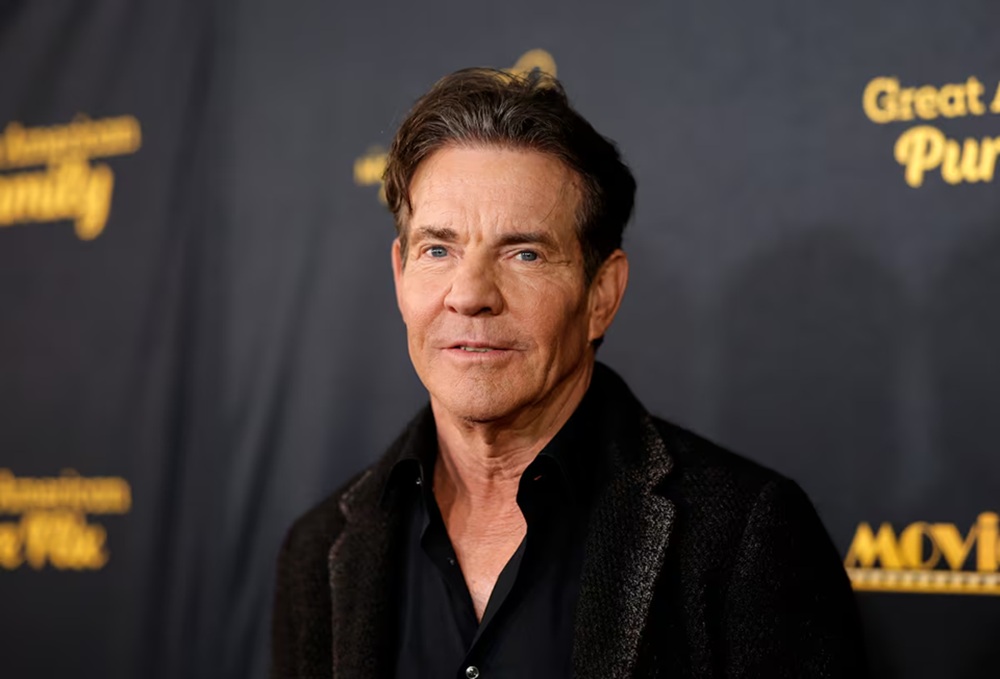

| Quick Facts | Details |
|---|---|
| Full Name | Dennis William Quaid |
| Date of Birth | April 9, 1954 |
| Birthplace | Houston, Texas, USA |
| Age (2026) | 71 years old (turns 72 on April 9, 2026) |
| Residence | Nashville, Tennessee |
| Height | 6 ft (1.83 m) |
| Religion | Christian (Baptist) |
| Occupation | Actor; musician; producer |
| Father | William Rudy Quaid — electrician |
| Mother | Juanita “Nita” Quaid (née Jordan) — real estate agent |
| Brother | Randy Quaid (older) — actor |
| High School | Bellaire High School, Texas — drama, dance, Mandarin Chinese |
| College | University of Houston — drama; dropped out to pursue acting |
| Film debut | September 30, 1955 (1977) |
| Career breakthrough | Breaking Away (1979) |
| Signature roles | Gordon Cooper (The Right Stuff, 1983); Jack Elliot (The Big Easy, 1987); Jerry Lee Lewis (Great Balls of Fire!, 1989); President Bill Clinton (The Special Relationship, 2010); Ronald Reagan (Reagan, 2024) |
| Production company | Bonniedale Films (co-founded with Laura Savoie) |
| Music | Dennis Quaid and the Sharks — guitarist, pianist, songwriter |
| Wife 1 | P.J. Soles (m. 1978; div. 1983) |
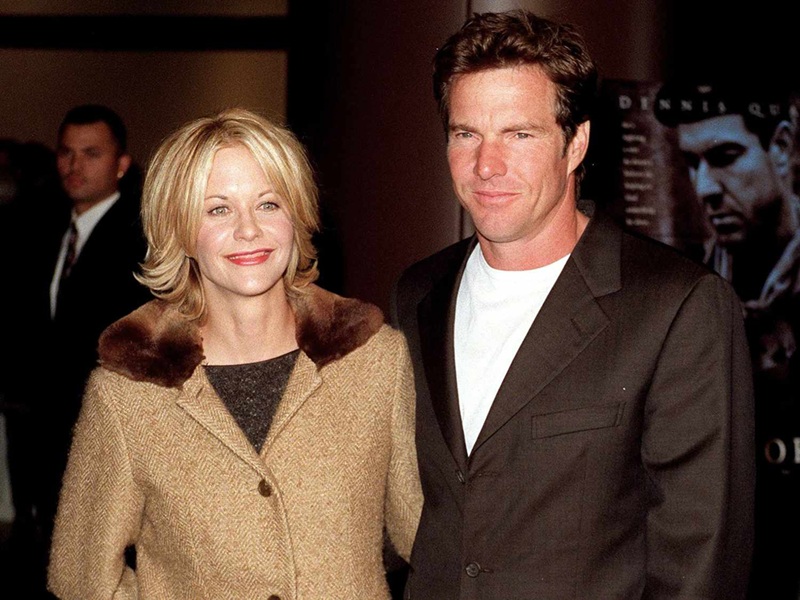
| Wife 2 | Meg Ryan (m. 1991; div. 2001) |
| Wife 3 | Kimberly Buffington (m. 2004; div. 2018) |
| Wife 4 | Laura Savoie (m. 2020 — present) |
| Son | Jack Quaid (b. April 24, 1992, with Meg Ryan) — actor, The Boys |
| Twins | Thomas Boone Quaid (b. Nov 8, 2007); Zoe Grace Quaid (b. Nov 8, 2007) — with Kimberly Buffington; both 18 in 2026 |
| Recent projects | Reagan (2024); Happy Face (2025, Paramount+); I Can Only Imagine 2 (Feb 2026); War Machine (March 6, 2026, Netflix) |
| Net Worth (2026 est.) | $40 million |
On March 6, 2026, Dennis Quaid appeared as General Sheridan in War Machine — a Netflix sci-fi action blockbuster that became an instant global number one on the platform. He was seventy-one years old. The film’s immediate commercial success was, in the specific context of a career that had been producing significant work for nearly five decades, entirely consistent with the trajectory of a man whose professional life has been characterised not by a single peak but by a series of reinventions — each one more surprising than the last, and each one demonstrating something the entertainment industry tends to forget about performers it has already categorised: that talent, combined with the specific discipline of someone who has survived genuine personal crisis, does not diminish with age. It recalibrates.
The story of Dennis Quaid is, in its most honest biographical framing, a story about persistence — not the glamorous persistence of someone who never doubted himself, but the specific, hard-won persistence of a man who lost forty pounds for a film role and developed anorexia nervosa, who admitted publicly to a cocaine addiction during a marriage whose end became tabloid material, who watched his ten-day-old twins nearly die from a hospital medication error, who went through four marriages before finding one that he describes as his closest, who moved to Nashville and co-founded a production company and played Ronald Reagan and a serial killer in consecutive projects and then fronted a Netflix global number one at seventy-one.
He is from Houston. He plays guitar in a band. He has a one handicap in golf. He is a licensed pilot. He is, by any fair accounting of the evidence, one of the more compelling biographical subjects that the American entertainment industry has produced across the past half-century.
Houston and Bellaire: The Formation
Dennis William Quaid was born on April 9, 1954, in Houston, Texas — the Gulf Coast city whose specific character, shaped by the petrochemical industry, the NASA space centre, and the particular heat and humidity of the Texas coastal plain, gave him the formation of a Southern Baptist, working-class household whose values were practical, religious, and deeply Texan.
His father, William Rudy Quaid, worked as an electrician — a skilled trade whose demands shaped the household’s daily rhythms and whose specific work ethic Dennis has cited in interviews as one of the most direct influences on his professional approach. His mother, Juanita “Nita” Quaid, née Jordan, worked as a real estate agent — the same profession that, by biographical coincidence, produced the family of Kimberly Buffington, his third wife. His older brother Randy Quaid would also pursue acting, whose career arc across the same era — significant early success, subsequent personal and legal difficulties — provides one of the more instructive contrasts in the history of Hollywood siblings.
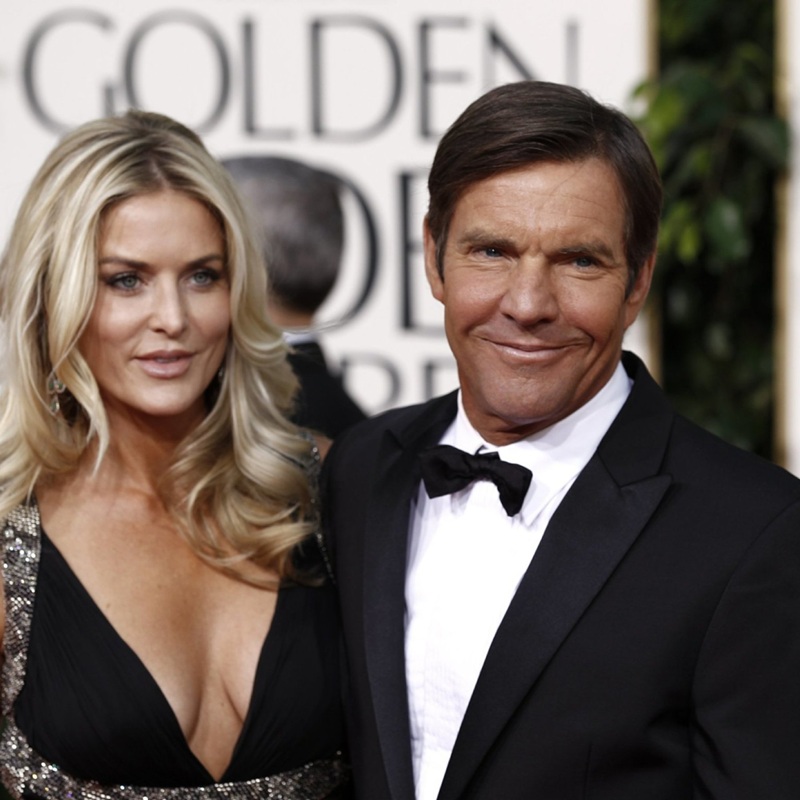
The family lived in Bellaire — the independent city entirely surrounded by Houston, whose quiet residential character and strong school system made it a standard destination for Houston’s professional middle class. Bellaire High School was where Dennis’s performing instincts found their first institutional expression: he studied drama and dance, and — in one of the more distinctive biographical details of any Hollywood actor’s high school years — took Mandarin Chinese, a subject whose presence in the curriculum and whose appeal to a Houston teenager in the late 1960s suggests the specific intellectual curiosity that his subsequent career would consistently reflect.
The University of Houston’s drama programme, where he studied under Cecil Pickett — the influential Texas acting teacher whose students included Randy Quaid, Robert Wuhl, and Brent Spiner — provided the formal training that preceded his departure from Houston. He dropped out before completing his degree, packed the specific ambition and the specific training that Houston and the University of Houston had given him, moved to Los Angeles with $800, and began the process of converting both into a career.
The Early Career and Breaking Away
The Los Angeles years of the mid-to-late 1970s produced the standard apprenticeship of a young actor building a résumé through guest appearances and supporting roles — the specific work of someone who is genuinely learning the craft in front of professional cameras rather than performing it. His film debut came in September 30, 1955 (1977) — a drama set on the day of James Dean’s death that gave him his first screen credit without giving him the breakthrough that his subsequent work would require.
The breakthrough came with Breaking Away (1979) — Peter Yates’s coming-of-age cycling drama set in Bloomington, Indiana, whose script by Steve Tesich won the Academy Award for Best Original Screenplay and whose ensemble cast included Dennis Christopher, Daniel Stern, Jackie Earle Haley, and Dennis Quaid in a supporting role that demonstrated the specific combination of physical energy and emotional accessibility that would define his most effective performances across the following decade. The film was made for approximately $2 million and grossed over $20 million — a commercial success at a scale that placed the entire cast in the industry’s awareness as people worth watching.
What followed was the specific decade of professional accumulation that the 1980s provided for Dennis Quaid — a series of roles that individually did not quite crystallise the stardom his talent warranted but that collectively built the reputation, the range, and the commercial credibility that the decade’s best performances eventually confirmed.
The Right Stuff and the 1980s

The Right Stuff (1983) — Philip Kaufman’s adaptation of Tom Wolfe’s account of the early American space programme, running at three hours and eight minutes and nominated for the Academy Award for Best Picture — gave Dennis Quaid the role of Gordon Cooper, the Mercury astronaut whose test pilot bravado and competitive spirit made him one of the film’s most energetic presences. The ensemble cast — Sam Shepard, Ed Harris, Scott Glenn, Fred Ward, Dennis Quaid — was among the most accomplished assembled for an American film of that decade, and Dennis Quaid’s contribution was central to the film’s emotional dynamics.
He moved across genre and tone through the decade with the versatility that his best work has always demonstrated. Jaws 3-D (1983) was, by his own candid assessment, not among the films whose legacy he prizes. Dreamscape (1984) and Enemy Mine (1985) placed him in the science fiction territory that the decade’s technical capabilities made commercially significant. The Big Easy (1987) — in which he played New Orleans detective Remy McSwain, a charming corrupt cop whose relationship with an ethics investigator played by Ellen Barkin produced one of the decade’s more genuinely erotic film romances — demonstrated his capacity for the specific combination of Southern charisma and moral ambiguity that his Texas formation equipped him for. Innerspace (1987) — the comedy in which he played a miniaturised pilot injected into Martin Short’s body — was both a commercial success and the film on whose set he met Meg Ryan, who played his co-star.
Great Balls of Fire! (1989) gave him the challenge of playing Jerry Lee Lewis — the Louisiana rock and roll pioneer whose specific combination of musical genius, personal excess, and Southern Baptist contradiction required the full range of physical and musical preparation that Dennis brought to it, learning piano at performance standard for the role and delivering a performance whose specific energy captures something genuinely true about its subject.
Addiction, Anorexia, and the Personal Crisis
The personal difficulties of the 1990s — which Dennis Quaid has discussed with unusual openness across multiple interviews — are the biographical chapter whose acknowledgement defines his public identity as much as any professional achievement.
He admitted publicly to a cocaine addiction during the period of his marriage to Meg Ryan — a habit that he described as affecting his work, his marriage, and his sense of himself, and whose treatment required the sustained commitment that recovery from addiction demands. The public acknowledgement, at a time when celebrity substance abuse admissions were less normalised than they have subsequently become, reflected the specific character of a man who processed his difficulties by naming them rather than managing them through euphemism.
For Wyatt Earp (1994) — Lawrence Kasdan’s three-and-a-half-hour historical western in which Dennis played the consumptive Doc Holliday — he lost approximately forty pounds through extreme dietary restriction and physical depletion. The weight loss was, by his own subsequent account, the trigger for an episode of anorexia nervosa — the eating disorder that, when it develops in men, is frequently connected to the specific pressures of a performance environment that measures physical transformation as professional commitment. He recovered, though the experience left its specific imprint on his understanding of the relationship between professional demands and personal wellbeing.
The marriage to Meg Ryan (1991–2001) — one of the most publicly documented Hollywood relationships of its era — ended following Dennis’s acknowledgement of the cocaine addiction and the specific strains that his honesty about it produced in a relationship whose public image had been among the more wholesome in the industry. Their son Jack Quaid was born on April 24, 1992, during the marriage — and Jack’s subsequent career, building a significant profile as Hughie Campbell in Amazon’s The Boys, represents a professional achievement whose independence from both parents’ careers is the clearest available evidence that he was well raised.
The Career Revival and 2000s Peak
The late 1990s and early 2000s produced the career revival that Dennis Quaid’s talent had always warranted but that the specific circumstances of his personal difficulties had temporarily obscured. The Parent Trap (1998) — the Disney family film starring Lindsay Lohan in a dual role as twins who conspire to reunite their separated parents — placed him in a commercial mainstream context that demonstrated his capacity for the warmth and accessibility that family filmmaking requires.
Any Given Sunday (1999) and Traffic (2000) placed him in the ensemble dramas of Oliver Stone and Steven Soderbergh respectively, whose critical weight gave his professional revival the prestige dimension it needed. Frequency (2000) — the science fiction drama in which he plays a father communicating with his son across time — was both a commercial success and a film whose emotional intelligence reflected the specific quality of a performer who had been through enough personal difficulty to play parental love with genuine rather than performed feeling.
The Rookie (2002) — the true story of Jim Morris, a high school baseball coach who makes the major leagues at thirty-five — grossed $80.7 million worldwide against a modest budget and demonstrated his specific capacity for the kind of inspirational drama that American cinema has always valued most when it is grounded in genuine athletic and emotional substance. Far From Heaven (2002) — Todd Haynes’s Sirkian melodrama in which Dennis played a closeted husband in 1950s suburban Connecticut — produced some of the strongest critical assessments of his dramatic capability, earning him a Golden Globe nomination, the Independent Spirit Award for Best Supporting Male, and recognition from the New York Film Critics Circle.
The Day After Tomorrow (2004) — Roland Emmerich’s climate catastrophe blockbuster — grossed over $500 million worldwide, placing Dennis Quaid at the centre of one of the decade’s most commercially significant productions and confirming that the career revival of the late 1990s had established something permanent rather than temporary.
Television and the Reagan Chapter
The television work that Dennis Quaid has produced across the past fifteen years reflects the same range and ambition that his film career demonstrated — and includes some of the most critically noted performances of his career.
The Special Relationship (2010) — the HBO film about the Blair-Clinton relationship — cast him as President Bill Clinton, a performance whose physical transformation, vocal accuracy, and specific comic timing earned him Emmy, Golden Globe, and Screen Actors Guild nominations and demonstrated the capacity for real-person performance that his subsequent work would continue to explore.
Lawmen: Bass Reeves (2023) — the Paramount+ series about the first Black US Marshal west of the Mississippi — placed him in an important historical drama at the edge of its ensemble without dominating it, demonstrating the mature professional generosity of a performer who no longer needs to be the centre of every scene he inhabits.
Reagan (2024) — his portrayal of President Ronald Reagan across the biographical film that had been in development for years — was the role whose arrival generated the most industry anticipation of his recent career. His physical resemblance to Reagan, combined with the vocal preparation and the specific combination of folksy charm and political conviction that the character required, produced a performance that the film’s audience — particularly its faith-oriented base — received with enthusiasm.
Happy Face, I Can Only Imagine 2, and War Machine: The Third Act
The convergence of three significant projects within fourteen months confirms that Dennis Quaid’s current career chapter is the most commercially productive since his 2000s peak.
Happy Face (2025) — the Paramount+ series in which he plays the real-life “Happy Face” serial killer Keith Jesperson — represented the most dramatically challenging role of his recent work, requiring the specific moral capability of portraying genuine evil with sufficient humanity to sustain dramatic interest without generating the simple revulsion that makes a serial killer portrayal unwatchable. The critical reception was strong, with multiple reviewers noting the specific quality of his work as the production’s central achievement.

I Can Only Imagine 2 (February 2026) — the sequel to the 2018 faith-based film — continued the trajectory of his engagement with Christian cinema that has become one of the more distinctive dimensions of his recent professional identity. His description of his current marriage as grounded in shared Christian faith — and his public statements about how that faith has shaped his life’s current chapter — connect directly to the kind of material he has chosen to make in his early seventies.
War Machine (March 6, 2026) — as General Sheridan in this Netflix sci-fi action blockbuster — became an instant global number one on the platform, confirming that at seventy-one, Dennis Quaid can anchor a major streaming action production with the commercial draw that major platforms require before they commission at that scale.

Nashville, Laura Savoie, and Bonniedale Films
Dennis Quaid and Laura Savoie married in 2020 — a relationship whose forty-year age gap generated significant public commentary but which Dennis has addressed in his own terms across multiple recent interviews, describing it as his closest relationship and attributing its specific quality to their shared Christian faith and their aligned sense of what they want their lives to contain.
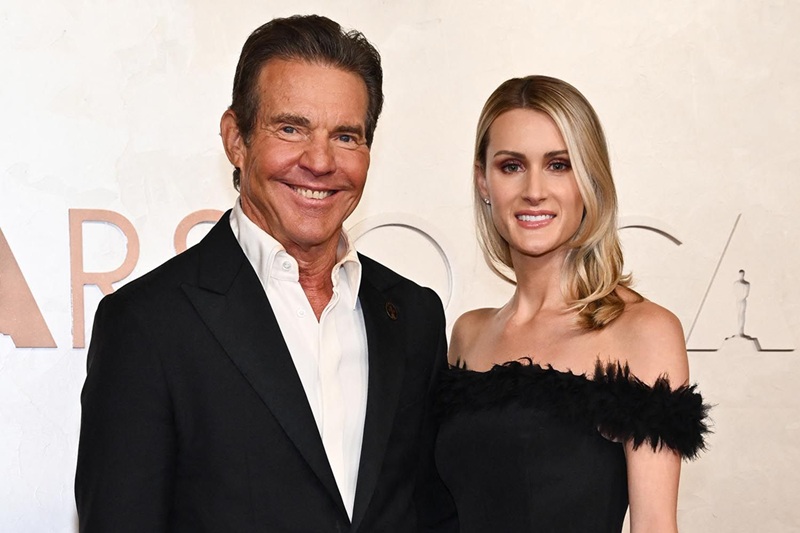
They have relocated to Nashville, Tennessee — a city whose specific combination of music industry infrastructure, Southern community character, and evangelical Christian culture aligns with both of their personal and professional identities. From Nashville, they operate Bonniedale Films — the production company they co-founded, whose output is oriented toward the faith-based and family entertainment market that represents a growing segment of the American streaming audience.
The Nashville relocation and the production company represent the specific life architecture of a man who has decided what the next chapter looks like and is building the institutional and geographic infrastructure to support it — away from Los Angeles, closer to the musical and faith-based communities that align with his current values, and with a professional partner who shares both.
His twins Thomas Boone and Zoe Grace are eighteen years old in 2026 — the age at which college preparation, the specific threshold of adult independence, and whatever they have made of growing up as the children of one of Hollywood’s most recognisable actors converge into the lives they are beginning to build independently.
His son Jack Quaid continues building a career whose quality reflects both the genetic inheritance and the specific upbringing that one parent’s well-publicised difficulties and two parents’ eventual genuine co-parenting produced.
Net Worth: The Forty Million Picture
| Income Source | Estimated Contribution |
|---|---|
| The Right Stuff, The Big Easy, Great Balls of Fire! (1980s) | Established career fees |
| The Rookie, Far From Heaven, The Day After Tomorrow (2000s) | Peak film earnings |
| The Special Relationship, Vegas, Fortitude (television) | Cable/streaming drama fees |
| Reagan (2024) | Lead film fee |
| Lawmen: Bass Reeves (2023, Paramount+) | Streaming drama fee |
| Happy Face (2025, Paramount+) | Streaming drama fee |
| I Can Only Imagine 2 (February 2026) | Faith-based film fee |
| War Machine (March 2026, Netflix) | Major streaming action lead fee |
| Bonniedale Films production company | Ongoing |
| Dennis Quaid and the Sharks — music | Additional |
| Real estate — Nashville; Montana ranch; historical properties | Asset value |
| Estimated Total Net Worth (2026) | $40 million |
Conclusion
Dennis Quaid was born in Houston, Texas, on April 9, 1954, the son of an electrician and a real estate agent, the younger brother of a man who would also become a famous actor. He studied Mandarin Chinese in high school, dropped out of the University of Houston’s drama programme with $800 and a specific ambition, and built a career that has now spanned five decades and includes some of the most commercially significant films of three different eras of American cinema.
He lost forty pounds for a role and developed anorexia. He admitted publicly to a cocaine addiction. He went through four marriages. He watched his ten-day-old twins nearly die from a hospital overdose and testified before Congress about what that experience revealed about patient safety. He played Bill Clinton and got Emmy nominated. He played Ronald Reagan. He played a serial killer. He became an instant Netflix global number one at seventy-one.
He lives in Nashville now, with his fourth wife, running a production company built on shared Christian faith. His twins are eighteen. His eldest son is a star. He plays guitar in a band. He can land an airplane.
He turns seventy-two on April 9, 2026.