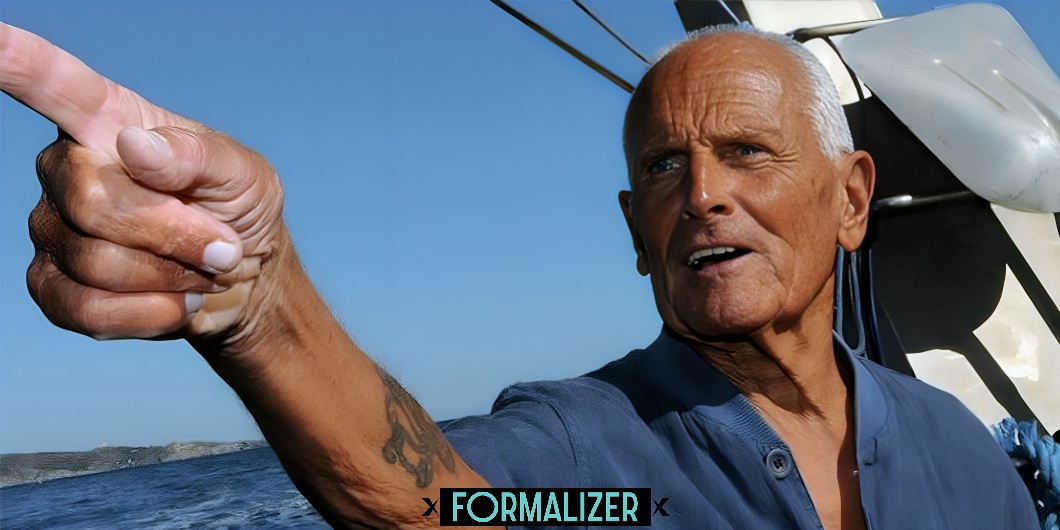

There are athletes who break records. And then there are athletes who break the very idea of what records are possible. Enzo Maiorca belonged firmly in the second category.
He was an Italian freediver from Syracuse, Sicily, who set 17 world records in breath-hold diving across a career spanning more than three decades. He was the first man to dive to 50 metres on a single lungful of air — at a time when the medical establishment genuinely believed that anything beyond 30 metres would crush a human body. He set his personal best of 101 metres at the age of 57. And long after the diving was done, he became one of Italy’s most passionate voices for ocean conservation.
Enzo Maiorca was born on 21 June 1931 in Syracuse, Sicily, and died on 13 November 2016 in the same city — 85 years old, rooted to the place and the sea that had defined his entire life.
Who Was Enzo Maiorca?
To people who know diving history, the name needs no introduction. To everyone else, here is the short version — Enzo Maiorca was the man who proved the experts wrong, over and over again, by simply going deeper.
He started freediving seriously in his mid-twenties and spent the next three decades pushing the boundaries of human physiology in ways that changed how scientists understood the body itself. Fierce, determined, occasionally controversial, and completely devoted to the sea.
| Detail | Information |
|---|---|
| Full Name | Vincenzo Maiorca |
| Date of Birth | 21 June 1931 |
| Birthplace | Syracuse, Sicily, Italy |
| Nationality | Italian |
| Sport | Freediving (breath-hold diving) |
| World Records | 17 (variable and constant weight) |
| Notable Achievement | First man to dive to 50 metres |
| Personal Best | 101 metres (1988, age 57) |
| Date of Death | 13 November 2016 |
| Age at Death | 85 |
Early Life — A Fear of the Sea That Became a Love Affair
Syracuse is a city where the Mediterranean is never far away. Its history runs back to ancient Greek settlers, its coastline is rugged and beautiful, and the sea has shaped its identity for thousands of years. It was into this world that Enzo Maiorca was born in 1931.
He learned to swim at age four and soon began to dive — despite expressing a genuine fear of the sea that stayed with him for years. That detail is worth sitting with. The man who would eventually become the greatest freediver of his generation spent his earliest years afraid of the very element he would later conquer.
Raised in a fishing family, Enzo developed a deep connection to the ocean and honed his diving skills along the rugged Sicilian shores. Spearfishing was part of daily life in coastal Syracuse — practical, social, and deeply embedded in local culture. He took to it naturally, and those early skills laid the physical foundation for everything that followed.
The true turning point came in 1956. A friend showed him a magazine article about a new depth record of 41 metres set by spearfishing champions Ennio Falco and Alberto Novelli. Something ignited in him. From that moment, Enzo Maiorca had one clear goal — to become the man who reaches the deepest.
A single article. That was all it took.
The Road to His First World Record (1956–1960)
Between reading that article and setting his first record, Maiorca trained with a focus that set him apart from other divers of his era. His approach was methodical — daily immersion in Mediterranean waters, incremental depth increases, and a mental toughness that he would later describe as the most important tool a freediver possesses.
He said in an interview: “I was breaking records step by step. I obeyed the doctors and didn’t dive deeper than 160 feet. And as I progressed I was learning more and coming to realise that the doctors were building walls based on beliefs that were wrong. Even Aristotle claimed a man could dive no deeper than 30 feet.”
That last line tells you everything about his mindset. He wasn’t reckless — he was methodical. But he refused to accept limits that hadn’t actually been tested by anyone willing to get in the water.
At just 29 years old, he crossed the 45-metre mark in July 1960, defeating Brazilian opponent Amerigo Santarelli and becoming world champion. Just weeks later, Santarelli reached 46 metres. Enzo came back in November of the same year and reclaimed it at 49 metres.
That back-and-forth with Santarelli — three records in four months — shows exactly the competitive fire he carried into every dive. He didn’t just want the record. He wanted it decisively.
Enzo Maiorca’s World Records — The Full Picture
Over his competitive career, Enzo Maiorca set 17 world records spanning two primary freediving disciplines and nearly three decades of competition.
Variable Weight is the most extreme discipline — divers descend on a weighted sled to a target depth and return to the surface using an air balloon or their own power. It allows the greatest depths but places the highest demands on the body.
Constant Weight requires the diver to descend and ascend entirely under their own fin power, with no buoyancy aids. It demands raw physical strength alongside breath control — a different kind of challenge entirely.
In 1961, Maiorca became the first man in history to reach 50 metres in constant weight. The medical establishment had said it was impossible. He did it anyway.
| Year | Depth / Achievement | Discipline | Notes |
|---|---|---|---|
| 1960 | 45 metres | Variable Weight | First world record; defeated Santarelli |
| 1960 | 49 metres | Variable Weight | Reclaimed same year from Santarelli |
| 1961 | 50 metres | Constant Weight | First man ever to reach 50 metres |
| 1964–1970 | Progressive records | Variable Weight | Steady advances through the 1960s |
| 1970 | 74 metres | Variable Weight | Sport’s governing body halted oversight |
| 1988 | 101 metres | Variable Weight | Final record and personal best, age 57 |
Each of those numbers represents a breath held, a body pushed, and a boundary moved. Across nearly three decades, he kept moving it.
Defying Medical Science — The Doctors Were Wrong
One of the most extraordinary threads running through Enzo’s career is how consistently the medical establishment tried to stop him — and how consistently he proved them wrong.
When he began pushing past 45 metres in the early 1960s, doctors weren’t merely cautious. They were certain. The human thorax, the experts declared, could not withstand the compression at those depths. The chest would implode. Death would follow.
Enzo went to 50 metres. His chest did not implode.
What the doctors hadn’t fully understood was the mammalian diving response — a set of ancient physiological reflexes triggered when the body is submerged. The heart slows dramatically, sometimes to as low as 20 beats per minute. Blood shifts away from the extremities and concentrates around the vital organs. The chest compresses in a controlled way rather than collapsing catastrophically.
Enzo didn’t know the science behind it. He just knew that the deeper he went, the more he learned about what his body could actually do — as opposed to what people on dry land thought it could do.
After his 74-metre dive in 1970, the sport’s governing body refused to preside over further record attempts, because doctors still considered the depths too dangerous. The officials withdrew. Enzo kept diving.
The 1974 TV Disaster — Live on RAI
By 1974, Enzo was Italy’s most famous diver and one of the most recognisable sporting figures in the country. The stage was set for something historic — a live, televised world record attempt that the entire nation would watch.
On 22 September 1974, in the Bay of Ieranto at the western end of the Gulf of Salerno, he attempted to reach 90 metres — the deepest freedive ever attempted at the time. It was the first live-televised freediving attempt in the history of RAI, Italy’s national broadcaster.
Less than 20 metres into the dive, he collided with a scuba diver who had been sent underwater to film the attempt. Enzo surfaced furious. And in front of the entire Italian nation watching live, he made his feelings known with a string of expletives that went out on national television, completely unfiltered.
The result was a years-long television ban and his retirement from competitive diving.
It’s one of sport’s great what-if moments. A man at the peak of his powers, poised to make history on live television, derailed by a collision six metres down. The frustration is completely understandable. The reaction was very, very human.
The Rivalry with Jacques Mayol — Sport’s Greatest Deep-Water Duel
Ask anyone familiar with freediving history who Enzo Maiorca’s greatest rival was, and the answer never changes — Jacques Mayol.
Mayol was a French freediver whose approach to the sport could not have been more different from Enzo’s. Where Maiorca relied on willpower, physical conditioning, and raw competitive drive, Mayol approached diving through meditation, yoga, and what he described as a near-mystical relationship with dolphins and the sea. They were opposites in almost every way — and their rivalry was electric precisely because of it.
The contrast ran deeper than technique. Enzo was Sicilian, passionate, fiery, and rooted to one place. Mayol was nomadic, philosophical, and more interested in what the sea meant than in how deep a man could go. Their competition was about numbers on paper. Their differences were about everything else.
In November 1976, Mayol became the first free diver to descend to 100 metres — a milestone Enzo had been building toward and that his rival reached first. It must have stung. But beneath the competition, both men maintained a complicated respect for each other.
Mayol himself later wrote about their rivalry: “Our duel was always fought at a distance, never on the same day and the same place. The true Enzo is much less surly, much more of a dreamer, idealistic and cerebral.”
Mayol died on 22 December 2001, taking his own life at his villa in Elba after struggling with depression. Enzo outlived him by fifteen years. The two men had defined an era of the sport together, and the sport was permanently diminished by Mayol’s passing.
The Big Blue (1988) — The Film, the Truth, and the Fury
In 1988, French director Luc Besson released Le Grand Bleu — known internationally as The Big Blue — a film inspired by the Maiorca-Mayol rivalry that became a global phenomenon. It introduced freediving to millions of people who had never heard of the sport and made both divers famous well beyond the diving world.
There was just one significant problem. Enzo despised it.
While the film presented a flattering, almost mythological portrait of Mayol, the character based on Maiorca — renamed “Enzo Molinari” and played by French actor Jean Reno — was portrayed as thuggish, hot-tempered, and largely unsympathetic. The connection to the real Enzo was obvious to everyone, regardless of the name change.
Maiorca initiated legal action against Besson and obtained a court injunction that prevented the film from being shown anywhere in Italy. It remained blocked for fourteen years — until 2002, shortly after Mayol’s death, when Enzo finally relented.
The film itself, it should be said, was heavily fictionalised in almost every direction.
| Element | In The Big Blue | Reality |
|---|---|---|
| Enzo character | Hot-headed, thuggish “Enzo Molinari” | “Dreamer, idealistic, cerebral” per Mayol |
| Depths reached | 400 feet (122 metres) | Maiorca’s best was 101m; Mayol’s 105m |
| Childhood friendship | Grew up together in Greece | Not confirmed in real life |
| Direct competition | Same day, same location | Rivalry was “always at a distance” |
| Enzo’s fate | Dies during a dive | Lived to 85, died peacefully in Syracuse |
| Film in Italy | N/A | Blocked for 14 years by Maiorca’s injunction |
The irony is that the film’s enormous popularity — the most financially successful French film of the 1980s — actually brought global attention to freediving and to Maiorca’s story. The sport benefited enormously from a film that one of its central figures refused to watch.
The Comeback — 101 Metres at Age 57
After the 1974 television disaster and the long retirement that followed, most people assumed Enzo Maiorca’s competitive chapter was closed. He was in his forties, then his fifties. Younger divers were pushing new depths. The sport had moved on.
Then, in 1988, he came back.
Spurred by watching his daughters Rossana and Patrizia compete at world-class level, and energised by the publicity surrounding The Big Blue, Enzo returned to the water with a purpose. That year, at the age of 57, he descended 101 metres into the Mediterranean on a single breath and came back up again.
It was his personal best. Set twelve years after his last competition, at an age when most competitive athletes have long since retired.
In the same year that a film was depicting a fictionalised version of his rivalry, the real Enzo Maiorca was quietly producing the most remarkable result of his career. He didn’t need a screenplay. He simply went diving.
It stands as one of the great comeback stories in all of sport — not because of the record itself, but because of what it says about the man who made it.
The Grouper Moment — When a Hunter Became a Guardian
In 1967, something happened in the Bay of Syracuse that changed Enzo’s relationship with the sea permanently — and it had nothing to do with a record.
He was spearfishing, as he had done hundreds of times before. He harpooned a large grouper, and a struggle broke out underwater. The fish retreated into a cavity between two rocks. Enzo reached in after it, and his hand ran along the fish’s belly.
He felt its heart beating — pounding in terror, in pain, in panic.
In his own words: “Something clicked in me and that was it. I never speared another fish because I felt like a terrorist.”
The speargun went into the basement that day. It never came out again.
From that moment, Maiorca the hunter became something else entirely. He became a vegetarian. He began speaking publicly about the intelligence and sensitivity of sea creatures. He turned the fame he had built as a record-breaker into a platform for ocean protection.
One grouper’s heartbeat, felt beneath the surface of the Bay of Syracuse. It changed everything.
The Dolphin Rescue — A Family Story
If the grouper story explains the private transformation, the dolphin rescue shows what that transformation looked like in practice — and it is one of the most beautiful stories in the history of the sport.
While diving in the Mediterranean with his daughters Rossana and Patrizia, Enzo felt a nudge on his back and turned to find a male dolphin in the water beside him. The animal was agitated, insistent — clearly communicating something. Enzo followed it down.
About 40 feet below the surface, the dolphin led him to its mate — a pregnant female who had become entangled in a fishing net and was close to drowning.
Enzo surfaced immediately, grabbed diving knives, and went back down with Rossana and Patrizia. Together, the three of them cut the dolphin free and helped her reach the surface. Shortly afterward, the dolphin gave birth.
As Enzo later recalled: “As soon as she was on the surface, after breathing out foam and blood, she gave birth to a dolphin calf under the watchful eyes of her mate.”
And then, while they were still in the water, the male dolphin circled back — and pressed its beak against Enzo’s cheek. A gesture that everyone who heard the story interpreted the same way.
Three Maioircas in the Mediterranean. A new life born at the surface. And a dolphin’s quiet thank you.
Marine Conservation — The Sea Advocate
After his final competitive record in 1988, Enzo didn’t retire into quiet obscurity. He turned his fame and his platform entirely toward the sea he had spent his life entering.
He worked tirelessly to raise awareness of the threats facing the world’s oceans — pollution, overfishing, habitat destruction, and climate change. He appeared on Lineablu, a RAI environmental broadcast series, from 2000 to 2002, bringing ocean awareness into Italian living rooms on a regular basis.
It was fitting, in its way, that the medium which had banned him for an expletive in 1974 became, three decades later, the platform for his most important work.
He frequently quoted a line that captured his entire philosophy: “Until a man learns to respect and speak to the animal world, he can never know his true role on Earth.”
The man who had once hunted the sea spent the second half of his life defending it. That arc — from spearfisher to conservationist, from record-chaser to ocean guardian — is as remarkable as any depth he reached.
Politics, Books, and Later Life
Enzo’s life after competitive diving was anything but quiet.
From 1994 to 1996, he was elected to the Italian Senate for the Alleanza Nazionale party, bringing the same directness to parliament that he had brought to the water. By most accounts, he found the sea considerably more satisfying than the corridors of political power.
He was also a prolific writer, producing four books over the decades that documented his life, his philosophy, and his relationship with the ocean:
| Book Title | Year |
|---|---|
| Headlong into the Blue: The Life and Business of a World Record | 1977 |
| School Apnea | 1982 |
| The Sea with a Capital S | 2001 |
| Under the Sign of Tanit | 2011 |
He appeared as himself in the 1975 film Challenge on the Bottom, directed by Melchiade Coletti — one of the rare occasions he allowed a camera to document his diving on his own terms.
His 80th birthday was celebrated in La Spezia with the conferring of the Award of the Maritime Festival — a recognition of a lifetime devoted to the sea that he loved and feared in equal measure as a boy.
A personal detail that only emerged after his death: in 1977, he had been initiated into Scottish Rite Freemasonry at the Archimede di Siracusa Lodge. This was publicly revealed in 2017 with the agreement of the Grand Orient of Italy — a quiet dimension of a very public life.
Family Legacy
The Maiorca name didn’t belong to Enzo alone. He built something rare in sport — a genuine family dynasty rooted in the same water and the same values.
Both daughters became serious competitive freedivers. Patrizia competed at world-class level and later became president of the Plemmirio Marine Protected Area near Syracuse — continuing the family’s commitment to ocean conservation in a formal institutional role. She keeps the Maiorca name connected to the sea in a very practical, ongoing way.
Rossana set multiple world records across different freediving disciplines and was one of the most accomplished female freedivers of her generation. She passed away on 7 January 2005, aged 45, following a battle with cancer. By all accounts, her death was the deepest personal loss of Enzo’s long life — a father outliving his daughter by eleven years, carrying that weight quietly for the rest of his days.
The Premio di Laurea “Maiorca” — an academic prize established in 2026 for young researchers in marine biology and environmental science — ensures that both Enzo and Rossana’s names remain permanently connected to the future of the sea they both served.
| Family Member | Role | Legacy |
|---|---|---|
| Enzo Maiorca | Freediver, senator, conservationist | 17 world records, “Lord of the Abysses” |
| Rossana Maiorca | Freediver | Multiple world records, died 2005 aged 45 |
| Patrizia Maiorca | Freediver, conservationist | Records holder, Plemmirio Marine Reserve president |
Death and Tributes
Enzo Maiorca died on 13 November 2016 in Syracuse — the same city where he had been born 85 years earlier.
There is something quietly perfect about that symmetry. Born in Syracuse, died in Syracuse, the Mediterranean always nearby. A man who spent his life going as deep as any human had ever gone, always returning to the same shore.
The tributes came from across the diving world, from Italian sports institutions, from environmental organisations, and from ordinary people who had grown up watching him or first discovered his name through The Big Blue. International newspapers ran obituaries. The Italian Senate acknowledged the passing of a former member. Diving publications around the world devoted pages to the life he had lived.
He was a former spearfisher who defied medical experts and broke world records by swimming to depths of more than 300 feet on a single breath — and in doing so, brought the sport of freediving to a mainstream audience that had never known it existed.
That was his professional achievement. But his human achievement was something else — the grouper in the bay, the dolphin at the surface, the daughters in the water beside him, the books written in his later years, the television appearances arguing for the ocean’s survival.
He went deeper than any man before him. And he came back changed every time.
FAQs
What is Enzo Maiorca famous for? Enzo Maiorca is famous for being one of the greatest freedivers in history, setting 17 world records in breath-hold diving, becoming the first man to dive to 50 metres on a single breath, and inspiring the 1988 Luc Besson film The Big Blue through his legendary rivalry with French freediver Jacques Mayol.
How many world records did Enzo Maiorca set? He set 17 world records across variable weight and constant weight freediving disciplines, across a career spanning from 1960 to 1988. His personal best was 101 metres, achieved at the age of 57.
What is The Big Blue based on? The Big Blue is a heavily fictionalised film inspired by the real-life rivalry between Enzo Maiorca and French freediver Jacques Mayol. The character “Enzo Molinari,” played by Jean Reno, was based on Maiorca — a portrayal he found so objectionable that he obtained a court injunction blocking the film’s release in Italy for 14 years.
Did Enzo Maiorca and Jacques Mayol get along? Their relationship was complex — genuine sporting rivalry combined with mutual respect. Mayol described Maiorca as “a dreamer, idealistic and cerebral” beneath the competitive exterior. Both men acknowledged each other’s greatness, even as they spent careers trying to outdo one another.
What happened to Enzo Maiorca’s daughters? Both daughters — Rossana and Patrizia — became accomplished competitive freedivers. Rossana passed away in January 2005 at age 45 from cancer. Patrizia continued her connection to the sea through conservation work and serves as president of the Plemmirio Marine Protected Area near Syracuse.
Conclusion
Enzo Maiorca’s story is really the story of a man and a sea — and how a relationship that began in childhood fear became a lifelong love, a professional obsession, and eventually a moral calling.
He started diving because he read about someone else’s record and decided he could go deeper. He ended his competitive career with 17 world records and a personal best achieved at 57. In between, he felt a grouper’s heartbeat and never killed another living thing in the water again. He freed a pregnant dolphin with his daughters and felt its mate press against his cheek in gratitude. He blocked a film he hated from being shown in his own country for fourteen years because he refused to let a fictional version of himself replace the real one.
None of it fits neatly into a single narrative. That’s what makes him worth knowing.
The Lord of the Abysses feared the sea as a boy. He spent his life going back into it anyway — deeper and deeper, breath by breath — until the records ran out and the conservation work took over. When he finally left, he did so in Syracuse, the Mediterranean just a few minutes away.
Some men are born to the sea. Others choose it. Enzo Maiorca did both.