Adam Pearson: The Man From Croydon Who Turned His Diagnosis Into the Most Powerful Argument for Disability Representation in Cinema

| Quick Facts | Details |
|---|---|
| Full Name | Adam Pearson |
| Date of Birth | January 6, 1985 |
| Birthplace | Croydon, South London, England, UK |
| Age (2026) | 41 years old |
| Nationality | British |
| Height | 5 ft 7 in (170 cm) |
| Condition | Neurofibromatosis type 1 (NF1) — diagnosed age 5 after bump to head at age 5 that did not heal |
| Operations | 33+ operations to remove tumours |
| Vision | Blind in one eye; losing sight in the other |
| Twin brother | Neil Pearson — identical twin with same NF1 diagnosis; manifests differently: epilepsy and memory loss rather than facial tumours; medical paper written about the brothers’ divergent manifestations |
| Parents | Marilyn and Patrick Pearson — retired; live in South London |
| Childhood | Grew up in Croydon; tumours spread visibly across face by age 8; daily bullying at school; nicknames based on The Elephant Man and The Hunchback of Notre Dame |
| Coping resource | Changing Faces charity — provided coping mechanisms during hospital visits to Great Ormond Street |
| Secondary school | Croydon — described bracing himself daily: “take a deep breath before walking through the gates and try to hang on” |
| University | University of Brighton — B.A. Business Management |
| Early career | BBC and Channel 4 researcher; worked on The Undateables and Beauty and the Beast: The Ugly Face of Prejudice; casting researcher |
| How he got into acting | Charity for people with facial differences contacted him; led to audition for Under the Skin (2013) |
| Film debut | Under the Skin (2013) — Jonathan Glazer; alongside Scarlett Johansson; improvised scenes |
| Theatre | The Elephant Man (2014) — London stage; played Thomas Carr (not Merrick) |
| Chained for Life | (2019) — Aaron Schimberg; explored disability representation in filmmaking |
| Breakthrough film | A Different Man (2024) — Aaron Schimberg; A24; opposite Sebastian Stan and Renate Reinsve; Oswald; Sundance premiere; Berlin Competition |
| A Different Man awards | Independent Spirit Award nomination; CFCA Best Supporting Actor nomination; CFCA Most Promising Performer; National Board of Review recognition; film won Gotham Best Picture; Stan won Golden Globe Best Actor (thanked Pearson in speech) |
| A Different Man quote | “In order to challenge stereotypes, they first need to establish they exist” |
| Oswald character | Confident, charismatic man with NF1 who becomes the most compelling person in any room he enters; described as carrying the film’s real power |
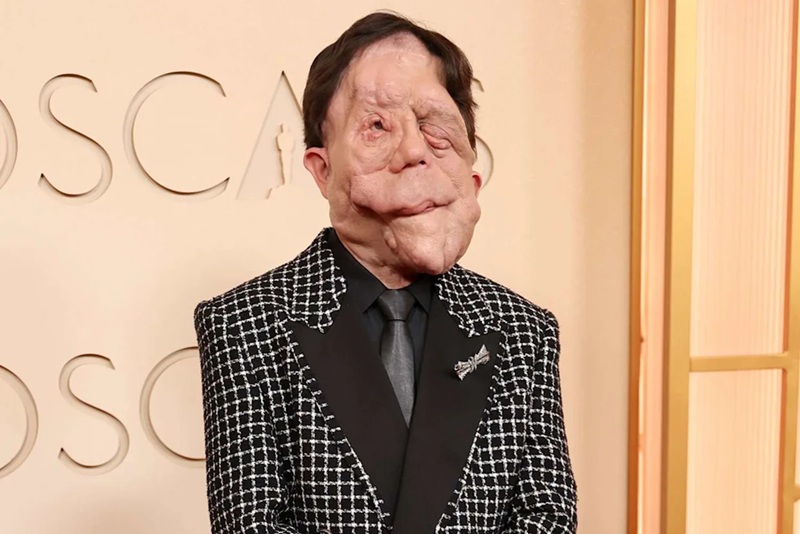
| 98th Oscars | Walked red carpet at Dolby Theatre, March 15, 2026; wore monochrome check Amiri suit; black shirt and tie; silver star-shaped brooch by Past and Precious |
| Elephant Man film | Announced May 2025 — playing Joseph Merrick in new film adaptation of Bernard Pomerance’s Tony-winning play; screenplay by Moby Pomerance (Bernard’s son); filming spring 2026; first disabled actor to play the role on screen |
| Presenter/documentary | Horizon: My Amazing Twin (BBC); Beauty and the Beast (Channel 4, Series 1 presenter); Celebrity MasterChef (BBC contestant); multiple documentaries |
| Awards/recognition | UK Documentary Presenter of the Year nomination — Grierson Awards 2016; BAFTA appearance 2025/2026 |
| Advocacy | Patron of Face Equality International (2024); Changing Faces supporter; anti-bullying advocacy; representation campaigner |
| Key quotes | “My disability has opened more doors than it has closed”; “The more people see it in wider society, the less stigma there is”; “I want to be as normal as possible” |
| Residence | Addiscombe, South London |
| Relationship | Single (confirmed publicly) |
| Net worth (est.) | £300,000–£500,000 (modest; career focused on advocacy alongside acting) |
On March 15, 2026, the red carpet at the Dolby Theatre in Hollywood was the usual extraordinary display of celebrity, fashion, and calculated visibility. Adam Pearson walked it wearing a monochrome check Amiri suit with black satin lapels, a black shirt and tie, and a silver star-shaped brooch by Past and Precious. He raised his chin. His gaze was directed upward and to the side. The full extent of the tumour growth across his face — the visible consequence of the neurofibromatosis type 1 he was diagnosed with at the age of five — was not obscured or minimised. He was simply there, as himself, at one of the most photographed events on the annual cultural calendar.
For anyone living with a visible difference who has ever taken a breath before walking through a door, seeing a face like theirs on that stage is not a small thing. It is, for some, the first time they have seen it at all. The kid from Croydon, as Pearson put it himself, has done good.
He had spent his secondary school years bracing himself daily at the school gates — taking a deep breath before walking through and trying to hang on. He had spent his childhood learning his nicknames from the children who watched The Elephant Man and The Hunchback of Notre Dame on television and arrived at school the next morning with fresh material. He had spent over thirty years undergoing surgeries — 33 operations to remove tumours, blind in one eye, losing the sight in the other — and had built, from the specific materials of that experience, a career whose trajectory had brought him from a BBC researcher’s desk to the Oscars red carpet and to a casting announcement as the first disabled actor to play Joseph Merrick on film.
“My disability has opened more doors than it has closed,” he has said. The sentence is neither denial nor performance. It is the specific, hard-won assessment of someone who has examined the evidence with the clear eye of someone who had every reason to reach a different conclusion, and chose this one anyway.
Croydon, the Bump That Didn’t Heal, and the Diagnosis
Adam Pearson was born on January 6, 1985, in Croydon, South London — the large suburban borough whose specific character, shaped by its position on the commuter belt south of London, its diverse community, and the particular atmosphere of a place that is neither the city’s glamorous centre nor its rural periphery, gave him the formation of someone who grew up close enough to everything to reach it and far enough from it to have to try.
He was born alongside his identical twin brother Neil — and their shared genetics, and what those shared genetics would produce in each of them differently, is the biographical fact that has contributed to medical literature as well as to personal history.
After he hit his head at the age of five, the resultant bump persisted instead of healing. The diagnosis was neurofibromatosis type 1 — the most common form of a genetic disorder that causes non-cancerous tumours to grow on nerve tissue, affecting approximately one in 2,500 people. By the age of eight, the tumours had spread visibly across his face.
The specific cruelty of what followed was ordinary in the most devastating sense: the cruelty of other children was not far behind. “Anytime ‘The Elephant Man’ or ‘The Hunchback of Notre Dame’ was on TV, the next day I’d hear that nickname,” he recalled. Secondary school required the specific daily psychological preparation of someone who knows that the space they are about to enter will require them to manage other people’s reactions before they can do anything else: bracing himself to “take a deep breath before walking through the gates and try to hang on.”
The distinction between Adam’s experience and his twin brother Neil’s is one of the most medically unusual documented cases of NF1’s variable expression. Neil carries the same genetic condition but has been affected in entirely different ways, experiencing memory loss and epilepsy rather than facial tumours. The medical contrast between the two has been so unusual that a paper has been written about them. NF1’s unpredictability — the fact that identical twins with identical DNA can manifest the same condition in categorically different forms — is both medically significant and personally profound for the Pearson brothers: their shared genetic inheritance produced entirely separate lives, separated by the specific lottery of expression that the disease conducts without reference to the person it affects.
During his regular visits to Great Ormond Street Hospital for treatment, Adam discovered Changing Faces — the British charity that provides support to individuals and families living with conditions affecting their appearance. The charity provided him with coping mechanisms and encouraged a positive mindset, reinforcing the idea that people who teased his appearance were the ones with the problem, not him. The framing is simple. Its practical application across years of secondary school in Croydon was not.
His parents, Marilyn and Patrick Pearson, maintained what Adam has described as a positive household orientation — the specific decision of parents who understood that their son’s formation of a positive self-image in the face of sustained external negativity required sustained internal support.
University of Brighton and the Years Behind the Camera
Adam Pearson’s journey into the entertainment industry began not as an actor but as a professional on the production side. After secondary school in Croydon, he attended the University of Brighton, where he studied Business Management — a practical, commercially oriented degree whose specific intellectual content was less important than the credential and the independence it represented.
After graduating, he worked as a researcher for the BBC and Channel 4, contributing to shows including The Undateables and Beauty and the Beast: The Ugly Face of Prejudice. The specific programmes he worked on were not incidental to his subsequent career direction: The Undateables is a Channel 4 documentary series following people with unusual conditions or disabilities who are looking for romantic relationships; Beauty and the Beast: The Ugly Face of Prejudice is a Channel 4 series examining society’s attitudes toward facial disfigurement and disability. Adam Pearson, working as a researcher and casting contributor on programmes whose subject matter was the lived experience of people who looked different — was, in a specific professional sense, using his insider understanding of that experience before he had found the medium in which his own presence would be the thing under examination.
He subsequently became a presenter in his own right: he fronted the first series of Beauty and the Beast: The Ugly Face of Prejudice as a strand presenter, and appeared in various documentaries including BBC Horizon’s My Amazing Twin — the programme whose subject matter was precisely the divergent manifestation of NF1 between himself and Neil, bringing their extraordinary medical case to a national television audience.
The Grierson Award nomination for UK Documentary Presenter of the Year in 2016 was the formal industry recognition of his presenting work — the acknowledgement that his specific combination of personal authority on the subject, natural camera presence, and communicative clarity made him one of the year’s most effective documentary presenters.
Under the Skin (2013): A Charity Call, an Audition, and Scarlett Johansson
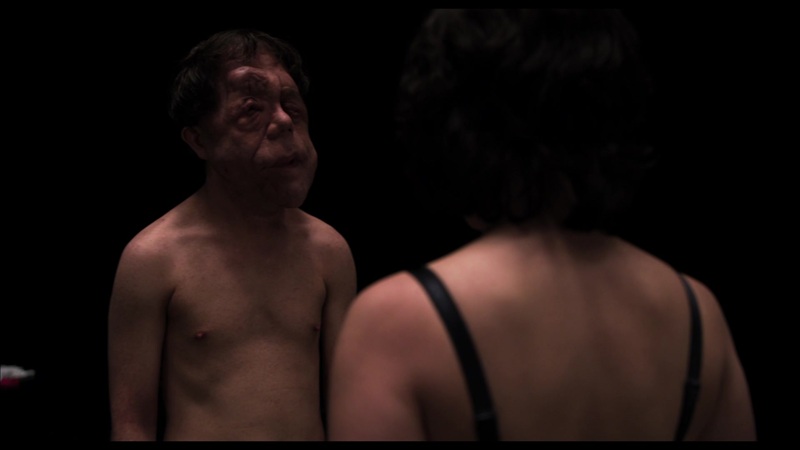
The specific mechanism through which Adam Pearson became an actor rather than continuing as a presenter and researcher is one of the more distinctive origin stories in recent British film history. A charity for people with facial differences contacted him, which led to an audition for a role alongside Scarlett Johansson in Under the Skin.
Under the Skin (2013) — Jonathan Glazer’s science fiction film in which Johansson plays an alien entity in human female form who drives around Scotland luring men — is a film whose specific approach to the question of how humans interact with visible difference gave Adam Pearson’s appearance its most powerful cinematic deployment: the alien’s reaction to him, and what that reaction reveals about the specific humanity she encounters in someone whose face the conventional world has difficulty looking at directly. The scenes, often improvised, depict a raw and honest portrayal of human interaction that challenges preconceived notions.
He used the opportunity not only to perform but to argue. Pearson seized the opportunity to challenge the film industry’s tendency to use facial imperfections as shorthand for evil. He also emphasises the need for actors with conditions to play characters with the same conditions, rather than relying on prosthetics. The argument — that authentic casting is both the right choice artistically and the right choice ethically, and that the industry’s habitual use of prosthetics to simulate disability perpetuates the specific othering that it claims to challenge — was, in 2013, a more radical position than it would subsequently become. It has since moved closer to industry consensus, partly because Adam Pearson has been making the case consistently for more than a decade.
The film’s critical reception placed him on the radar of the specific world of independent cinema whose practitioners were prepared to think carefully about who should play whom and why.
Chained for Life (2019): Aaron Schimberg and the First Collaboration
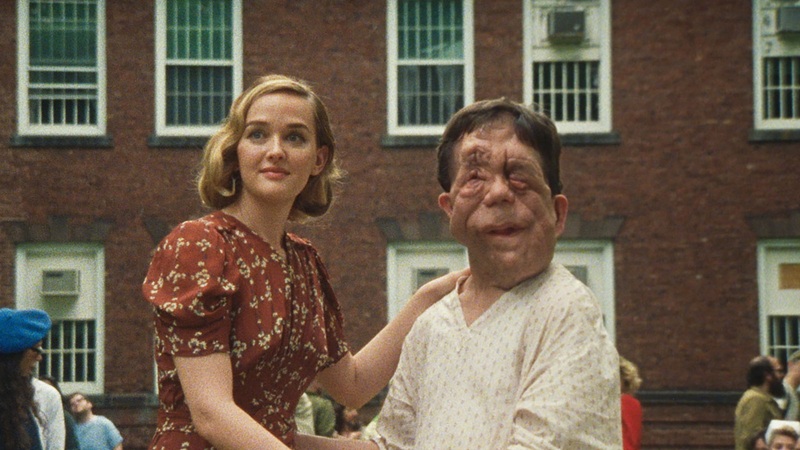
The director whose work has most completely understood what Adam Pearson’s presence can do in a film is Aaron Schimberg — whose first collaboration with Pearson, Chained for Life (2019), was a film whose specific subject matter — the ethics and aesthetics of casting disabled performers in Hollywood productions — was the most direct cinematic treatment of the questions that Pearson had been raising in interviews and advocacy work since Under the Skin.
The film’s premise: a production company making a horror film casts a disfigured actress in the lead, and the dynamics between the conventional Hollywood film set and the performers brought in from outside its standard casting pool produce a sustained examination of who gets to tell whose story and on whose terms. Pearson’s role in the film — an actor with a visible difference whose specific experience of the industry’s machinery is both the film’s subject and its method — was the clearest available demonstration that Schimberg was the filmmaker who understood most precisely what it meant to use Pearson’s presence rather than simply to document it.
It established a creative partnership whose second iteration would produce the most significant film of Adam Pearson’s career to date.
A Different Man (2024): Oswald, the Most Compelling Person in Any Room
A Different Man premiered at the Sundance Film Festival on January 21, 2024, and screened in Competition at the 74th Berlin International Film Festival on February 16, 2024, where Sebastian Stan won the Silver Bear for Best Leading Performance. It was released in the United States by A24 on September 20, 2024.
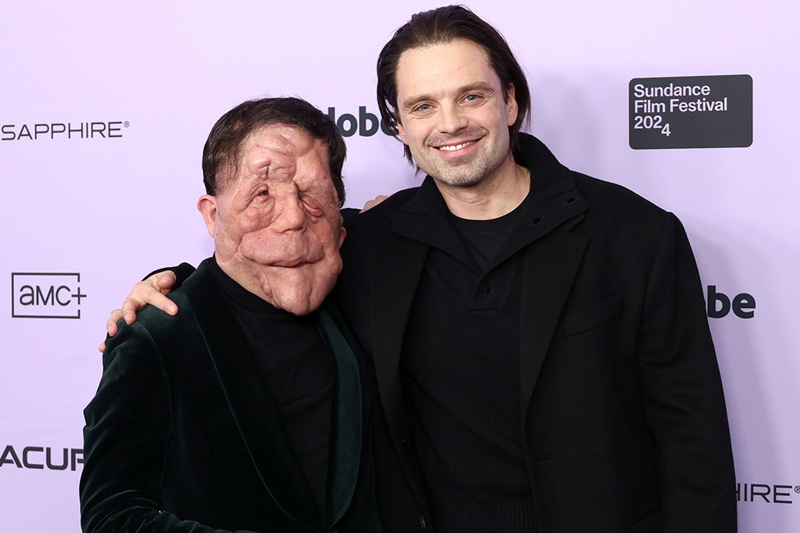
The film’s premise is the most formally inventive treatment of disability representation that mainstream cinema had produced in years: Edward, an actor with neurofibromatosis who undergoes an experimental procedure to change his face, only for his new life to make past insecurities and new issues apparent. As Edward rebuilds his life with his new face, he becomes obsessed with an actor — Adam Pearson, who has the affliction in real life — who is cast to play him in a stage play based on his life.
Adam Pearson’s character, Oswald, is the film’s philosophical centre — and its most joyful presence. It is the work of Adam Pearson that gives the film its real power. If there is anyone who deserves to be a bigger name after A Different Man, it’s Adam because his charm offensive is carrying the film from start to finish. His entrance alone makes you take notice, he has an undeniable aura about him that just pulls you in and you can see how he can make it through a world that might push people who look like him aside just on charm alone.
The specific creative decision embedded in Oswald’s characterisation — a man with NF1 who is not the film’s tragic figure but its most confident, most socially capable, most fully alive presence — is the argument made in film form that Adam Pearson has been making in interviews for over a decade. Oswald does not suffer for being who he is. Oswald exceeds.
The film’s awards recognition was substantial: when Sebastian Stan won the Golden Globe for Best Actor in a Musical or Comedy, he specifically thanked Adam Pearson in his speech: “Aaron Schimberg and Adam Pearson at home, I wish you were here. I share this with you. Thank you for your trust.” The film won the Gotham Award for Best Picture. Pearson received nominations for the Independent Spirit Award and the CFCA Best Supporting Actor prize, and was recognised for Most Promising Performer by the Chicago Film Critics Association.
He described the film’s approach with the characteristic directness of someone who had thought about it for years before having the specific vehicle to express it: “In order to challenge stereotypes, they first need to establish they exist.”
The Elephant Man: The First Disabled Actor to Play Joseph Merrick on Film
In May 2025, the most significant casting announcement of Adam Pearson’s career was made: he will play Joseph Merrick — the Victorian man whose severe physical deformities made him the subject of both medical fascination and public spectacle — in a new film adaptation of Bernard Pomerance’s Tony Award-winning play The Elephant Man. The screenplay has been written by Pomerance’s son, Moby Pomerance. Filming is slated to begin in spring 2026.
Pearson’s casting makes him the first disabled actor to play this role in a film. The previous cinematic treatment was David Lynch’s 1980 film, in which John Hurt played Merrick under extensive prosthetics — a landmark film whose artistic achievement does not diminish the specific significance of now casting a disabled performer in the role.
The parallel between Merrick’s biography and Pearson’s own is not one that the casting announcement has made the central argument — which is as it should be — but whose existence is not incidental. Both men have lived in a body whose appearance provoked the world’s reaction before its inner life had the opportunity to be assessed. The specific indignity of being assessed by your appearance before anyone has had the chance to know your name is the shared biographical experience whose artistic transformation, when a disabled actor plays the Victorian man who endured it, has a specific authenticity that no amount of prosthetics can replicate.
Face Equality International and the Advocacy That Is Not Separate From the Career
In 2024, Pearson became a patron of Face Equality International, an alliance of Non-Governmental Organisations, charities and support groups which are working at national, regional or international levels to promote the campaign for ‘face equality’. The organisation’s name contains the specific argument that Pearson has been making in interviews since 2013: that the equal treatment of people with visible differences is not a niche charitable concern but a civil rights matter whose framing as “face equality” places it in the same conceptual space as gender equality, racial equality, and disability rights more broadly.
In 2024, Oliver Bromley, who also has neurofibromatosis type 1, was reported to have been asked to leave a restaurant in south London because he was “scaring customers.” The proximity of that incident to Adam Pearson’s red carpet moment at the 98th Oscars is the measure of the specific distance between where the culture is and where it needs to go. Both things are true simultaneously: a man with NF1 was asked to leave a restaurant in south London, and a man with NF1 walked the Oscars red carpet in a tailored Amiri suit in Hollywood. The second thing does not resolve the first. It makes the urgency of the first more rather than less visible.
“The more people see it in wider society, the less stigma there is,” he has said. The logic is simple and evidenced: visibility does not solve prejudice, but its absence guarantees the specific prejudice of the unfamiliar, the reflexive discomfort of the person who has never had occasion to sit across from someone who looks like Adam Pearson and understand, as everyone who has does, that the face is not the person.
Conclusion
Adam Pearson was born in Croydon on January 6, 1985. He hit his head when he was five and the bump didn’t heal. He spent secondary school taking a deep breath at the school gates every morning and trying to hang on. He studied Business Management at Brighton. He researched television programmes about facial difference for the BBC and Channel 4. A charity for people with facial differences suggested he audition for Under the Skin, and Scarlett Johansson was in it, and the scenes were often improvised, and the film asked the question of what it means to look different in a world that judges appearance first. He worked with Aaron Schimberg on Chained for Life and then on A Different Man, in which he played the most confident man in any room he entered — the performance that made Sebastian Stan thank him in a Golden Globe speech. He underwent more than thirty operations. He is blind in one eye. He walked the Oscars red carpet in March 2026 and raised his chin. He is about to play Joseph Merrick — the first disabled actor to do so on film — in spring 2026.
His disability, he has said, has opened more doors than it has closed. The doors that it opened are different from the ones it closed. The ones it opened led to Scarlett Johansson in Scotland, to Aaron Schimberg’s camera, to A24, to the Dolby Theatre red carpet, to Joseph Merrick’s story. The ones it closed are not talked about, because the ones it opened were better.
He lives in Addiscombe, South London. He is still from Croydon. The kid from Croydon has done good.