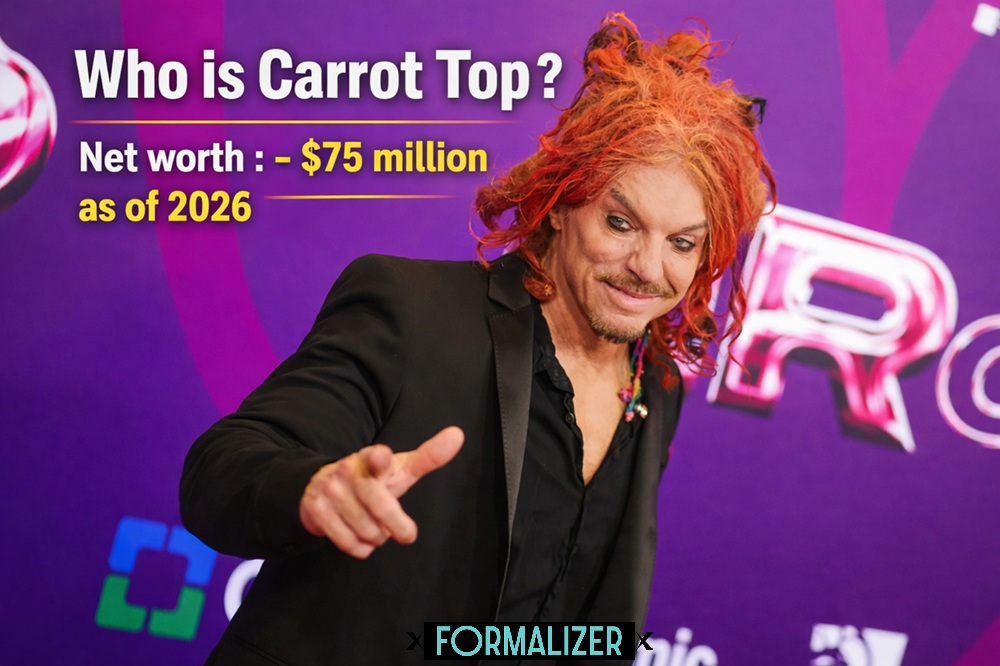

When people think of the richest comedians in the world, names like Jerry Seinfeld or Kevin Hart come to mind instantly. Carrot Top? Not so much. But here’s the thing — Scott Thompson, better known by his fiery-haired stage name, has quietly built a net worth estimated at $75 million as of 2026. That’s not a typo.
Most people still picture him as that loud, prop-wielding redhead from 90s infomercials. What they don’t realize is that he’s been selling out shows in Las Vegas for over two decades straight — and the money has been stacking up the entire time.
Who Is Carrot Top? — Quick Facts
Before getting into the dollars, here’s a snapshot of the man behind the trunk full of props.
| Detail | Info |
|---|---|
| Full Name | Scott Thompson |
| Stage Name | Carrot Top |
| Date of Birth | February 25, 1965 |
| Birthplace | Rockledge, Florida |
| Profession | Comedian, Actor, Producer |
| Known For | Prop Comedy, Las Vegas Residency |
| Net Worth (2026) | ~$75 Million |
| Current Residence | Las Vegas, Nevada |
He’s 61 years old in 2026, still performing regularly, and showing zero signs of slowing down. That alone says something.
From Florida to the Comedy Stage
Carrot Top didn’t grow up dreaming of Vegas lights. He was born in Rockledge, Florida, and had what most would describe as a pretty ordinary Midwestern-style upbringing in the South. His father was an engineer at NASA’s Kennedy Space Center — so ambition was clearly in the household DNA.

He attended Florida Atlantic University, originally studying business. But somewhere between lectures and late nights, he discovered comedy. He started performing at small campus events and local clubs, and the response was immediate.
What made him different from the start was the trunk.
Most comedians walk on stage with a microphone and their wits. Carrot Top walked on with a suitcase full of custom-made props — ridiculous, inventive, often absurd creations that he’d built or modified himself. It was weird. It was original. Audiences loved it.
He spent years grinding through the college circuit, which is actually one of the most lucrative touring routes for comedians — schools pay well, audiences are energetic, and the word spreads fast. By the early 90s, he had built a genuine following.
The Mainstream Breakthrough
Here’s something a lot of younger readers might not know: Carrot Top was everywhere in the 1990s.
The 1-800-CALL-ATT commercial campaign put his face in front of millions of American households. Those ads ran constantly, and they made him one of the most recognizable comedians of that era — not just among comedy fans, but with general audiences who’d never set foot in a comedy club.
That kind of exposure is hard to put a price on. It drove ticket sales, TV bookings, and eventually, a film deal.
In 1998, he starred in Chairman of the Board, a comedy film where he played a slacker inventor who inherits a corporation. Critics weren’t kind. It bombed at the box office. But here’s what’s interesting — it didn’t really hurt him. His core audience stayed loyal, and his touring income remained strong.
Late night television kept his name circulating too. He appeared on shows multiple times throughout the late 90s and 2000s, always bringing his props, always getting a reaction.
Las Vegas: The Decision That Changed Everything
If there’s one turning point in Carrot Top’s financial story, it’s 2005.
That’s the year he began his residency at the Luxor Hotel and Casino in Las Vegas. At the time, long-term comedy residencies in Vegas weren’t as common as they are today. It was a calculated bet — and it paid off beyond anything he likely imagined.
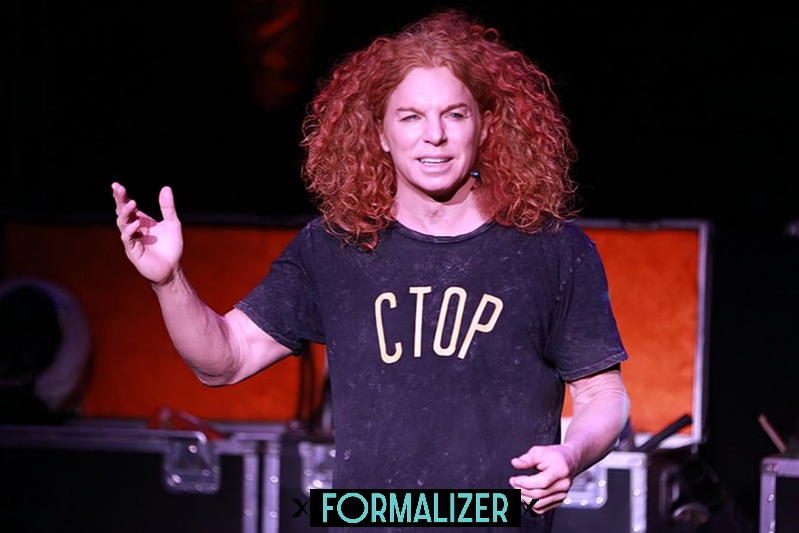
Over 20 years later, he’s still there.
Think about that for a moment. While other comedians from his generation faded from the spotlight, went broke, or spent years chasing relevance on the road, Carrot Top locked down one of the most stable entertainment gigs in the country. He performs multiple nights a week, year-round, at a major casino on the Las Vegas Strip.
His show at the Luxor isn’t just a comedy performance — it’s a full production. Elaborate props, physical comedy, rapid-fire jokes, audience interaction. It’s high energy and genuinely impressive from a logistics standpoint. He reportedly has an entire production team helping manage and build his props.
Estimates suggest he earns somewhere between $1 million and $2 million per year from the residency alone, factoring in his contract with the Luxor and ticket revenue. Over 20 years, that’s an extraordinary amount of compounding wealth.
Where the Money Comes From — Full Breakdown
His income isn’t just one stream. Here’s how it all adds up.
| Revenue Stream | Estimated Annual Earnings |
|---|---|
| Las Vegas Residency (Luxor) | $1M – $2M+ |
| Live Touring & College Shows | $200K – $500K |
| TV & Media Appearances | $100K – $300K |
| Brand Deals & Endorsements | $100K – $200K |
| Merchandise Sales | $50K – $100K |
| Total Estimated Annual | $1.5M – $3M+ |
The residency is clearly the engine. Everything else is fuel on top of it.
What’s smart about his setup is the consistency. He’s not chasing viral moments or betting everything on a Netflix special. He shows up, performs, and gets paid — week after week, year after year.
Net Worth Growth Over Time
His wealth didn’t appear overnight. It was built gradually, with the Vegas residency accelerating everything post-2005.
| Year | Estimated Net Worth |
|---|---|
| 2000 | ~$10 Million |
| 2005 | ~$20 Million |
| 2010 | ~$35 Million |
| 2015 | ~$50 Million |
| 2020 | ~$65 Million |
| 2025 | ~$72 Million |
| 2026 | ~$75 Million |
The growth curve tells the story clearly. Pre-Vegas, he was doing well. Post-Vegas, he was building real, lasting wealth.
Real Estate, Lifestyle & Assets
Carrot Top lives in Las Vegas — which makes sense given his work schedule. He owns property in the city and has been photographed at various local events over the years.
He’s not known for flashy spending in the way some celebrities are. No tabloid stories about private jet drama or reckless purchases. He comes across as someone who lives well but doesn’t throw money around carelessly.
One thing he has invested heavily in is his physical fitness. His body transformation over the years has been dramatic and well-documented. He went from a lanky, wiry comedian to someone who is visibly muscular and physically imposing on stage. He’s spoken publicly about his dedication to the gym, and it’s clearly become a significant part of his personal brand.
Whether you find the transformation striking or jarring, it signals something about his personality — he’s someone who commits fully to whatever he decides to do.
The Plastic Surgery Question
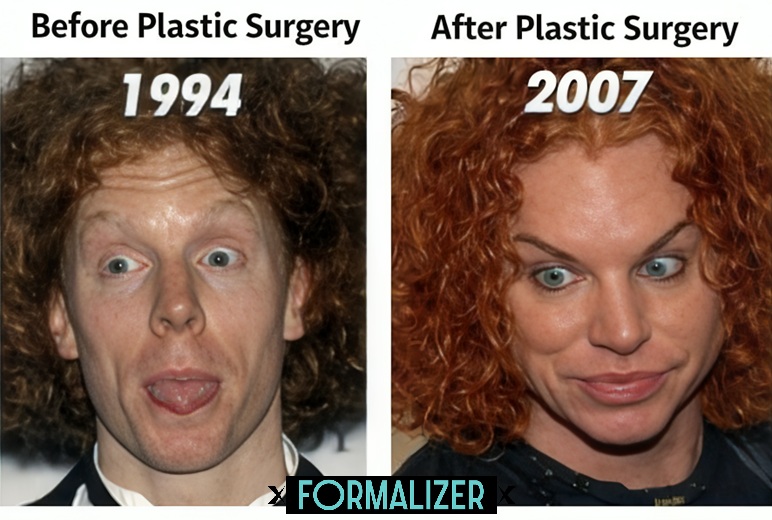
You can’t write about Carrot Top without addressing this. Over the years, his changing appearance sparked endless speculation about cosmetic procedures — Botox, fillers, possible surgical work.
He’s addressed it himself in interviews, neither fully denying nor going into specific detail. The conversation dominated a lot of coverage in the late 2000s and early 2010s.
Did it hurt his career financially? Not really. His Vegas bookings didn’t drop. His audience kept coming. If anything, the controversy kept his name in headlines during a period when he might have otherwise faded from public conversation.
It’s a strange footnote in his career — but financially speaking, it barely left a mark.
How He Stacks Up Against Other Comedians
Here’s some context for that $75 million figure.
| Comedian | Est. Net Worth (2026) |
|---|---|
| Jerry Seinfeld | ~$1 Billion |
| Jeff Dunham | ~$140 Million |
| Carrot Top | ~$75 Million |
| Gabriel Iglesias | ~$40 Million |
| Pauly Shore | ~$10 Million |
| Sinbad | ~$4 Million |
He sits comfortably in the upper tier of comedian wealth. Far ahead of many of his 90s contemporaries. The comparison to Gallagher is particularly striking — another prop comedian from a similar era who ended his life with almost nothing financially. The contrast is stark and largely comes down to one thing: business decisions.
Why He’s Still Relevant in 2026
Twenty-plus years at the same venue. Think about that in any other industry. A restaurant that’s been packed every night for 20 years is considered legendary. A musician with a 20-year residency at the same venue would be in the history books.
Carrot Top doesn’t always get that credit, but the numbers don’t lie.
A few things have kept him relevant beyond just showing up:
Social media has given him a new platform. He engages with fans, pokes fun at himself, and comes across as genuinely self-aware about his image — which audiences respond to.
The show itself keeps evolving. He’s not doing the same act from 2005. New props, new references, new material. The format stays consistent but the content refreshes.
Niche dominance. Nobody else is doing prop comedy at this level. He owns the lane completely. That kind of monopoly on a style is rare and valuable.
The Business Lesson in His Career
Strip away the red hair and the props, and what you have is a masterclass in career sustainability.
He found a format that worked. He found a venue that fit. He signed a long-term deal, showed up consistently, and let compound time do the rest.
Most entertainers chase the next big thing — the movie deal, the streaming special, the viral moment. Carrot Top built a machine and kept it running. In 2026, that machine is worth $75 million.
Final Verdict
Carrot Top’s net worth in 2026 sits at an estimated $75 million, and it didn’t happen by accident.
From college campus shows in Florida to two decades at one of Las Vegas’s most iconic venues, Scott Thompson played a long game while most people were busy underestimating him. The 90s kid who screamed into a phone for AT&T turned out to be one of the savviest financial operators in the comedy business.
Funny how that works.