GFXRobotection AI Software by GFXMaker – The Complete Guide to Protecting and Powering Your Creative Work

GFXRobotection is an AI-powered software developed by GFXMaker that does something most tools in the creative space don’t even attempt — it protects your digital graphics from theft, scraping, and unauthorized AI training while simultaneously helping you create better work faster. It’s not a watermarking plugin or a basic security add-on. It’s a full-stack creative protection system that embeds invisible digital fingerprints into your files, monitors the web in real time for unauthorized use, and uses machine learning to detect threats before damage happens.
What makes it stand out immediately is the dual function. Most tools either help you create or help you protect. GFXRobotection does both — and does them in the background, without disrupting your workflow or leaving ugly visible marks on your designs. If you’re a graphic designer, freelancer, agency, ecommerce seller, or content creator who shares work online, this software was built directly for the problems you face every day in 2026.
Who Is GFXMaker and Why Does It Matter?
Before trusting any software to protect your livelihood, it’s fair to ask who built it and whether they actually understand the problem.
GFXMaker has been in the graphics and creative tools space since 2015. They didn’t start as a cybersecurity company — they started as a team of people who understood graphic designers and the real frustrations of creative work: endless revisions, stolen portfolios, brand assets getting copied by competitors, and original work showing up elsewhere without credit or compensation.
That background matters. GFXRobotection isn’t built by a generic software company that decided “asset protection” was a good market to enter. It came from people who watched the problem get worse year after year — and then watched AI tools make it dramatically worse — and decided to build a specific solution for it.
Their team combines AI engineering with deep knowledge of how designers actually work, which is why the software integrates smoothly into existing creative workflows rather than demanding you change everything to accommodate it.
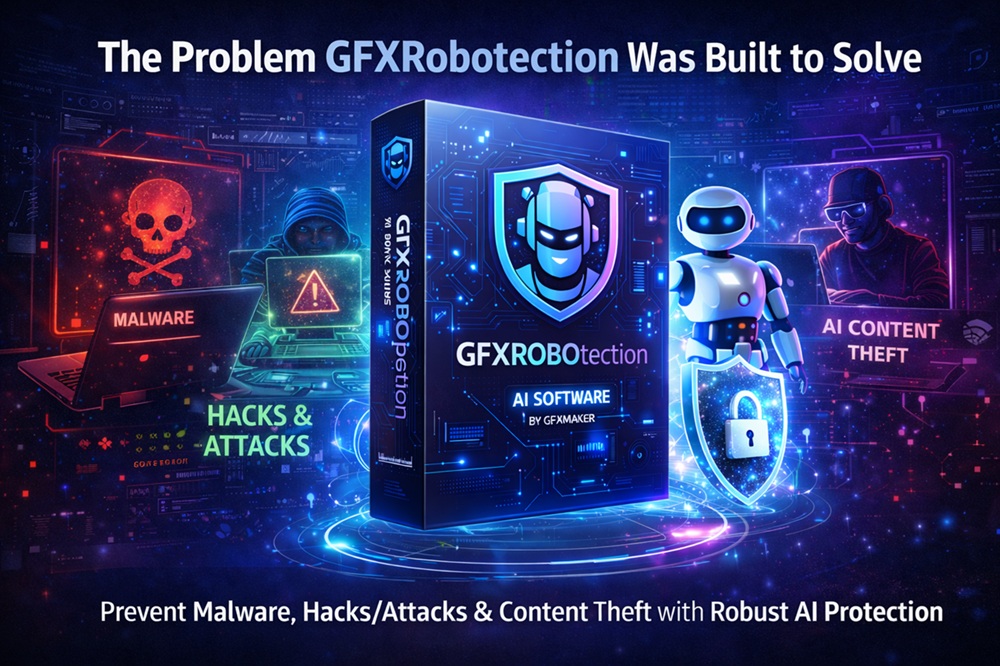
The Problem GFXRobotection Was Built to Solve
Let’s be direct about what’s happening in the creative industry right now.
Digital asset theft has always existed. Someone rips your photo, reposts your illustration, removes your watermark, sells your icon set on a different platform. That’s been going on for years. But 2024 and 2025 added a new and more troubling layer — AI image generation tools scraping the open web to train their models on existing creative work, often without permission, compensation, or even acknowledgment.
Your Behance portfolio. Your Instagram feed. Your client work published on a company website. All of it is potentially feeding someone else’s AI model, which then produces work in your style — or close enough to it — for their clients and their revenue.
Traditional protection tools weren’t built for this threat. Here’s how they stack up:
| Protection Method | What It Does | Where It Falls Short |
|---|---|---|
| Visible Watermarks | Marks ownership visually | Easy to crop out, ruins aesthetic |
| Basic DRM | Restricts file downloads | Doesn’t monitor use after distribution |
| Manual Search (Google Images) | Finds reposts manually | Time-consuming, misses most cases |
| Standard Metadata | Embeds creator info in file | Stripped out during re-saves or exports |
| GFXRobotection | Invisible fingerprinting + real-time monitoring + AI detection | Requires internet connection to monitor |
The gap between old-school protection and what GFXRobotection offers is significant. The old methods react after theft happens. GFXRobotection is proactive — it monitors continuously and flags issues before they compound.
Core Features — What the Software Actually Does
This is where it gets specific. GFXRobotection isn’t a one-trick tool. Here’s a breakdown of its main capabilities:
| Feature | What It Does | Who Benefits Most |
|---|---|---|
| Invisible Digital Fingerprinting | Embeds hidden ownership markers resistant to edits and compression | Designers, digital artists, photographers |
| Real-Time Web Monitoring | Continuously scans platforms for unauthorized use of protected files | Agencies, ecommerce brands, content creators |
| Smart Watermarking | Visible or invisible marks that don’t degrade visual quality | Freelancers sharing work with clients |
| AI Threat Detection | Machine learning identifies scraping bots, copy patterns, deepfakes | All users sharing work publicly |
| Metadata Ownership Proof | Timestamps and creator data embedded in every file | Freelancers in IP disputes |
| Role-Based Permissions | Granular control over who can view, download, or forward assets | Teams and agencies |
| Expiration & Revocation | Set access expiry or revoke instantly without manual cleanup | Client-facing deliverables |
| Platform Integrations | Syncs with Google Drive, Dropbox, Adobe CC, Figma, Slack | Teams working across multiple tools |
A few of these deserve a closer look.
Invisible Digital Fingerprinting is the core technology. These aren’t visible marks — they’re embedded data signatures that survive edits, compression, screenshots, and re-exports. If your image gets posted somewhere without permission, the fingerprint travels with it. When GFXRobotection’s detection system scans that image, it recognizes the signature and connects it back to you.
AI Threat Detection is what separates this from static security tools. The system learns what normal interaction with your files looks like — who accesses them, when, how frequently. When something deviates from that pattern (a sudden burst of downloads from unknown sources, access from unusual locations, repeated export attempts), it flags it and alerts you. No rule-setting required on your end.
Real-Time Web Monitoring runs continuously in the background. You don’t have to manually check Google Images or Tineye. If a protected asset appears somewhere online, the system catches it and sends you an alert through the dashboard.
The Design Creation Side — Protection Isn’t the Whole Story
One thing that catches people off guard is that GFXRobotection isn’t purely a security product. There’s a full AI-powered design creation engine built into it — which makes sense when you understand GFXMaker’s roots.
| Design Task | Manual Time Estimate | With GFXRobotection |
|---|---|---|
| Creating platform-specific ad sizes | 45–90 minutes | 5–10 minutes (batch export) |
| Generating layout variations | 1–2 hours | Near-instant AI drafts |
| Resizing one asset to 10 formats | 30–60 minutes | Automatic with one click |
| Applying brand guidelines to new project | 15–30 minutes | Instant once brand controls are set |
| Designing thumbnails for 20 videos | Several hours | Batch generation in minutes |
The AI scans thousands of design trends, color palettes, and real-world use cases to generate starting points. You give it a brief — platform, purpose, style preference — and it produces layouts, typography pairings, and composition options. Not finished work, but strong starting drafts that cut the blank-canvas problem significantly.
Bulk creation is genuinely useful here. Select a master asset, define the output formats you need (Instagram square, Facebook banner, YouTube thumbnail, Shopee product image), and the AI handles resizing, cropping, and optimization for each one. What used to take an afternoon now takes minutes.
Brand control settings let you lock in your core colors, fonts, and icon sets as defaults. Every new project starts from your brand foundation rather than from scratch.
How It Works — The Full Process
The workflow is straightforward, and that’s intentional. If protection required you to add five extra steps to every project, nobody would use it consistently.
Step 1 — Finish your design as normal. Nothing changes in how you create. Use Photoshop, Illustrator, Figma, Procreate — whatever’s already in your workflow.
Step 2 — Upload or export through GFXRobotection. This is the one added step. When you’re ready to share or distribute a file, it passes through the software. The AI automatically embeds the protection signature at this stage.
Step 3 — Share, publish, or deliver normally. Your file looks exactly the same. No visible marks, no quality degradation. It goes to your client, gets posted online, or lands in a shared folder — exactly as planned.
Step 4 — The system monitors continuously. From this point, GFXRobotection runs in the background. It’s scanning platforms, checking for your fingerprint appearing in unexpected places, monitoring access patterns, and watching for scraping behavior.
Step 5 — You get alerted if something’s wrong. If misuse is detected — unauthorized repost, scraping activity, suspicious download patterns — you receive a notification through the dashboard. From there you decide how to respond: takedown request, legal action, or simply revoking access.
The whole system is managed through a web dashboard that shows which assets are protected, where they’ve been detected online, who has access, and any active alerts.
Platform Integrations
A security tool that forces you to export everything manually into a separate system will get abandoned within a week. GFXRobotection clearly understood that.
Current integrations include:
- Creative tools: Adobe Creative Cloud, Figma
- Cloud storage: Google Drive, Dropbox
- Collaboration: Slack
- Developer access: API for custom pipeline integration
- Gaming engines: Unity and Unreal Engine (for game asset protection during playtesting)
- Ecommerce: Shopify and Amazon product content pipelines
The Adobe Creative Cloud integration is particularly useful for working designers. You can apply protection directly from within Photoshop or Illustrator via the plugin (Extensions > Add > GFXRobotection) without switching applications.
For agencies managing high volumes of assets across multiple clients, the API access means protection can be built directly into automated content pipelines rather than applied manually asset by asset.
Who Should Actually Use This?
Not every creator needs the same features. Here’s an honest breakdown:
| User Type | Primary Risk | Most Relevant Feature |
|---|---|---|
| Freelance graphic designers | Client work reused without permission | Fingerprinting + ownership proof |
| Digital artists (Behance, ArtStation) | Portfolio scraped for AI training | Invisible fingerprinting + monitoring |
| Marketing agencies | Brand assets copied by competitors | Role-based permissions + bulk protection |
| Ecommerce sellers | Product images stolen by rival stores | Real-time monitoring + watermarking |
| YouTubers / content creators | Thumbnails, overlays reposted without credit | Web monitoring + alerts |
| Startups building brand identity | Early brand assets vulnerable before legal protection | Metadata proof + access control |
| Photographers | Images used without licensing | Fingerprinting + takedown support |
If your work never leaves a private drive and you never share anything online, this tool probably isn’t necessary. But for anyone who publishes creative work to the web — even occasionally — the risk is real and growing.
GFXRobotection vs. The Competition
The creative software market is crowded. Here’s where GFXRobotection sits relative to what most designers are already using:
| Tool | Design Creation | IP Protection | AI-Powered | Web Monitoring | Best For |
|---|---|---|---|---|---|
| Canva | ✅ Strong | ❌ None | Partial | ❌ No | Casual social content |
| Adobe Express | ✅ Strong | ❌ Minimal | Partial | ❌ No | Adobe ecosystem users |
| Figma | ✅ Strong | ❌ None | Partial | ❌ No | UI/UX and team design |
| Traditional DRM Tools | ❌ None | ✅ Moderate | ❌ No | ❌ Limited | Enterprise document control |
| Basic Watermark Apps | ❌ None | ⚠️ Weak | ❌ No | ❌ No | Simple visible marking |
| GFXRobotection | ✅ Strong | ✅ Strong | ✅ Yes | ✅ Yes | Creators needing both |
The column that matters most is the last two. No other widely-used creative tool combines AI-powered protection with real-time web monitoring. That’s the gap GFXRobotection fills.
Canva and Adobe Express are excellent design tools. They’re not security tools. Using them doesn’t protect your work after you hit publish. GFXRobotection does.
Honest Limitations Worth Knowing
No software review should skip this part. GFXRobotection has real strengths, but it’s not a magic shield.
Internal leaks are harder to stop. If someone on your team with full credentials deliberately shares a file outside approved channels, the AI can detect unusual behavior — but it can’t stop a determined insider with legitimate access. Role-based permissions reduce this risk significantly, but they don’t eliminate it entirely.
It requires internet connectivity to monitor. The protection signatures are embedded locally, but the monitoring system needs to be online to scan for unauthorized use. Offline-only environments won’t get the full benefit.
It works best as one layer of a broader security approach. GFXMaker themselves are clear about this: pair the software with strong passwords, regular access audits, team security training, and clear policies about what gets shared and when. GFXRobotection is a powerful layer — it’s not a substitute for basic digital hygiene.
Some advanced features are still on the roadmap. Blockchain-based immutable proof of ownership and smart contracts for licensing are planned but not yet live. These will add significant value when they arrive, particularly for photographers and artists dealing with licensing disputes.
Getting Started — Practical First Steps
If you decide to try it, here’s how to approach the setup without overcomplicating things:
Week 1 — Audit your assets. Figure out what actually needs protecting. Client deliverables? Brand library files? Your portfolio? Product photography? Not everything requires the same level of protection.
Week 1 — Connect your primary workflow. Download the installer (Windows, macOS, or Linux), add the plugin to Photoshop or Illustrator, and connect the cloud storage you use most. Start with one integration, not all of them.
Week 2 — Set your access policies. Decide which assets are private (protected, no external access), shared (specific people with controlled access), or public (monitored but accessible). Role-based permissions work best when they’re set at the start of a project, not retrofitted after.
Week 2 — Run a trial on a real project. Apply protection to an actual deliverable going to a real client. See how it integrates with your normal process. If it adds friction you didn’t expect, adjust the workflow before rolling it out to everything.
Ongoing — Check the dashboard weekly. You don’t need to monitor it daily. A weekly review of alerts, access logs, and any detected misuse is enough to stay on top of things without it becoming a time drain.
Final Verdict — Is GFXRobotection Worth It?
For the right user, genuinely yes.
If you create digital work professionally and share it online — whether that’s client deliverables, portfolio pieces, ecommerce product images, or published content — the threat of unauthorized use is real and getting worse, not better. AI tools have made it easier than ever to copy, mimic, and misuse creative work at scale. GFXRobotection is one of the few tools built specifically to address that modern threat, not the threats of five years ago.
The dual function — protection and creation in one platform — is a real advantage. You’re not adding a security layer on top of your workflow; you’re replacing a gap in your workflow with something that actively makes you more productive and more protected at the same time.
It won’t solve every problem. No software will. But for designers, creators, and agencies who are serious about maintaining control over their work in an AI-driven landscape, it’s a tool worth taking seriously.
In 2026, being original isn’t enough. You have to defend it too — and GFXRobotection gives you a practical way to do exactly that.